
Phra Rod
Wat Mahawan (วัดมหาวัน), Lamphun · Traditionally attributed to Queen Chamadevi of Haripunchai (a hagiographic attribution, not documented fact)
History of the type
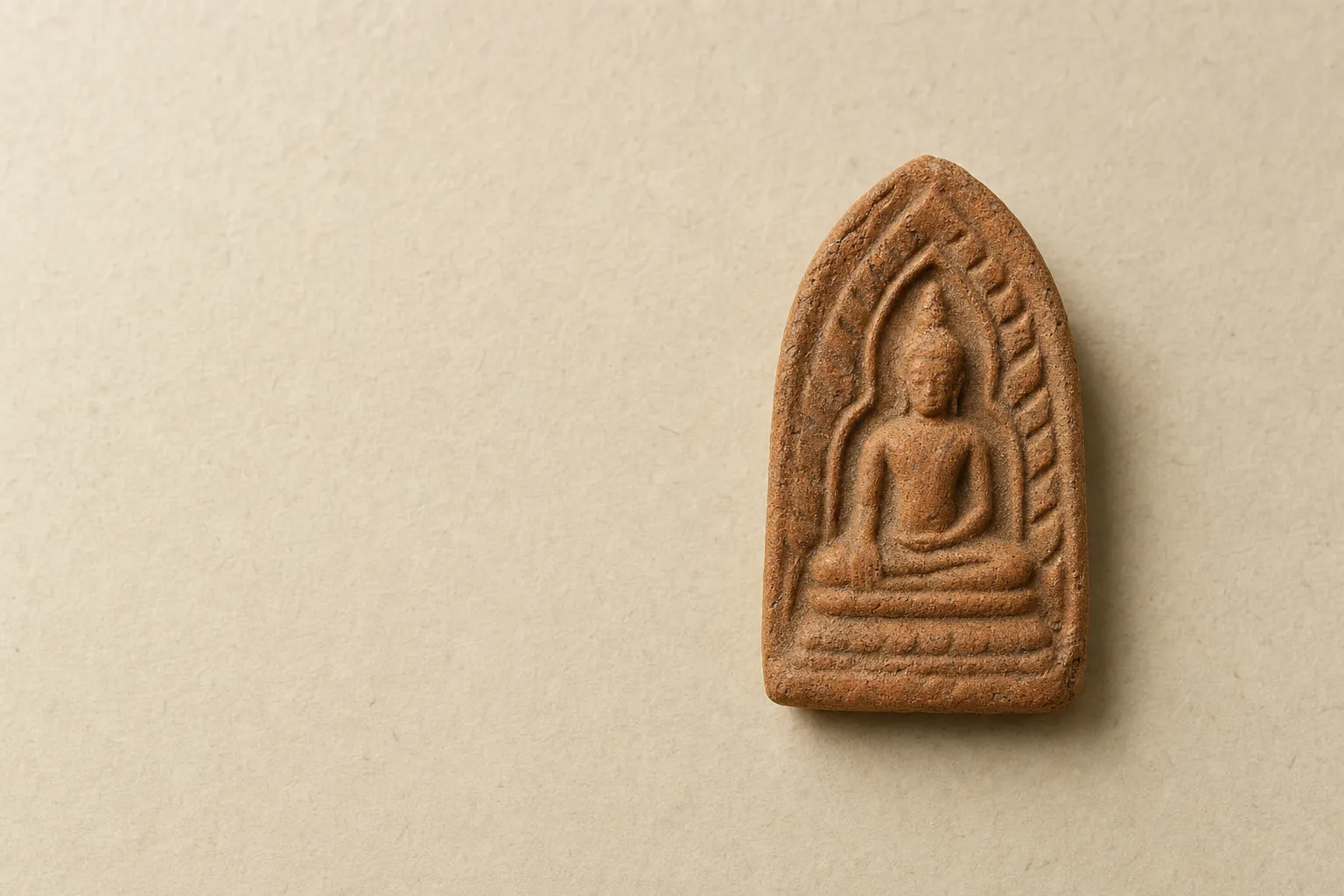
Phra Rod (พระรอด) is believed to be the oldest amulet type in the Benjapakee (เบญจภาคี) and represents the deepest historical stratum of the entire canon. The tablets are small fired-clay images of a seated Buddha set against a leaf-shaped backdrop, recovered from the kru (กรุ), the sealed relic chamber, of Wat Mahawan (วัดมหาวัน) in Lamphun in the north of Thailand. Art historians place the objects in the Dvaravati and Haripunchai cultural horizon, roughly the seventh to eighth century CE, which makes them ancient by any measure.
The name rod (รอด) means "to survive" or "to escape," and it has shaped the amulet's entire reputation. Traditional accounts attribute the first tablets to Phra Nang Chamadevi, the legendary founding queen of the Haripunchai kingdom. That attribution is hagiographic rather than documented: it belongs to devotional history and should be reported as legend, even though the great antiquity of the objects themselves is well established on art-historical grounds.
What is not in doubt is that Phra Rod sits at the origin point of the Benjapakee story, the oldest witness in a canon that later gathered four other types around it.
Materials and muan sarn
Phra Rod are made of fired clay, nuea din phao (เนื้อดินเผา) in collector language. Firing gave the tablets a hardness and durability that ordinary sun-dried clay lacks, and it is largely why so many survived centuries sealed underground before their rediscovery. The clay bodies range in tone from pale to dark depending on firing and burial, and the fabric of the material, its density and the small inclusions within it, is one of the things students of the type examine most closely. Because the tablets are ancient excavated objects rather than a compounded recipe, there is no muan sarn ingredient list of the kind associated with later powder amulets.

Consecration history
No consecration record survives for Phra Rod, which is unsurprising for objects of this age. They belong to the very old practice of sealing sacred images inside a kru to protect and perpetuate the religion, and their standing today rests on that antiquity, and on the survival that gives the type its name, rather than on any documented ceremony.
Notable editions
- Kru finds from Wat Mahawan, Lamphun (finite, excavated, no new production)
Cultural significance
Phra Rod carries two kinds of weight at once. As the oldest member of the Benjapakee it is the canon's historical anchor, the tablet that lets collectors speak of a tradition reaching back more than a thousand years. And through the meaning of its name it is strongly associated with khlaeo khlat (แคล้วคลาด), escape from harm, the narrow miss and the danger that passes by.
That pairing of deep antiquity with a protective promise built into the very word rod is central to why the type is so revered. It is emphatically a traditional collector object rather than temple-counter devotional ware, and encountering a genuine one is, for most enthusiasts, closer to a museum experience than an acquisition.
Market overview
Genuine Phra Rod trade only among the top tier of collectors, at prices reported in the hundreds of thousands to millions of baht for fine examples. Because the supply is fixed, limited to what has been excavated from the Wat Mahawan kru, and because condition and provenance vary enormously, the market is thin, specialised, and highly cautious. This is classical Benjapakee territory, not the world of affordable new production, and any figure quoted for it should be read as a snapshot of a rarefied and slow-moving market rather than a standard value.
Identification notes
Educational context only. LOKAVIDU does not authenticate amulets or issue verdicts.
Ancient excavated tablets are among the most demanding objects in the entire field to study, and this profile offers no checklist for them. Serious students proceed only through extensive documented references, comparison with securely provenanced examples, and long apprenticeship to specialists in this particular type.
LOKAVIDU provides historical and cultural context alone. We do not authenticate amulets, evaluate individual tablets, or issue verdicts. That responsibility rests entirely with experts handling the pieces in person.