
Ajahn Mun
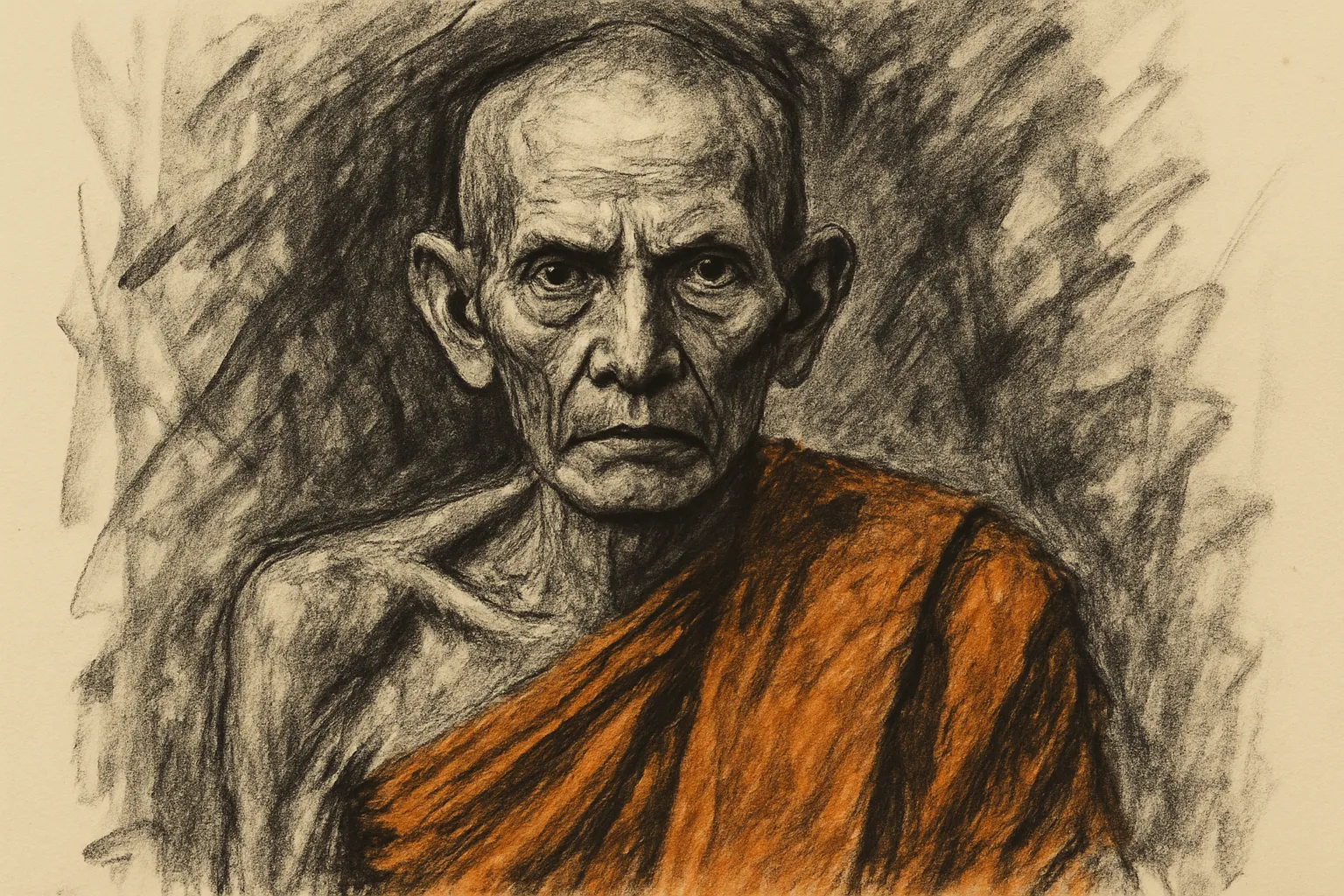
Phra Ajahn Mun Bhuridatta (พระอาจารย์มั่น ภูริทัตโต)
Wat Pa Suddhavasa (วัดป่าสุทธาวาส) · Sakon Nakhon
Deceased, 2492 BE (1949)
Path and reputation
Phra Ajahn Mun Bhuridatta is the patriarch of the modern Thai forest meditation tradition, the พระป่า or forest-monk movement, and arguably the single most influential meditation monk in modern Thai Buddhism. He was born in 2413 BE (1870) in Ubon Ratchathani, in the northeastern Isan region, and died in 2492 BE (1949) at Wat Pa Suddhavasa in Sakon Nakhon. Between those dates he reshaped the practice of an entire tradition.
Ajahn Mun revived the tudong, the practice of the wandering ascetic who walks the forests and villages with minimal possessions, and he insisted on a rigorous return to the Vinaya, the monastic discipline, at a time when much of Thai monasticism had grown settled and scholastic. His teaching produced a remarkable generation of forest masters. Ajahn Chah, Ajahn Thate, Ajahn Lee, Ajahn Waen, and Ajahn Fan, and virtually every other major forest monk of the twentieth century, stand in his lineage. His biography, written by his disciple Ajahn Maha Boowa under the title Venerable Acariya Mun Bhuridatta Thera: A Spiritual Biography, is the most widely read monk biography in Thailand.
His relationship to the amulet world is important to state precisely, because it is indirect. Ajahn Mun's own practice was meditation-focused, and the forest tradition he shaped generally de-emphasized sacred objects in favor of the inner work of the mind. He did not produce amulets in the modern sense, and it would misrepresent him to present him as a maker of consecrated objects. What he produced was practitioners and a standard of practice.
Yet his influence on the amulet world is real, and it runs through reputation rather than manufacture. Ajahn Mun established the forest monk as a figure of supreme barami, the accumulated moral perfection that Thai Buddhists attribute to an advanced practitioner, in the popular imagination. Once the forest master was fixed in the culture as the highest kind of practitioner, the perceived authority of forest-tradition monks to perform pluksek, the meditative consecration the tradition holds awakens a sacred object, rose with it. Many of his disciples' temples now produce amulets, and his own image appears on commemorative coins issued by temples across Isan. The amulet world, in other words, borrows the authority of a tradition that was itself ambivalent about amulets.

Notable editions
- Commemorative coins and images bearing his likeness (posthumous, issued by lineage temples)
Legacy
It is worth holding two things apart when reading Ajahn Mun through the lens of this site. The first is his personal practice, which was centered on meditation and strict discipline and did not involve the making of amulets. The second is the broader amulet world's relationship to his legacy, which is a separate matter shaped by others after his death. The commemorative coins and images that bear his likeness are memorial productions, made by his lineage temples to honor him, not lifetime productions that he consecrated or authorized. A reader who keeps that distinction clear will not mistake a posthumous coin for evidence that Ajahn Mun was an amulet maker.
His deeper mark on the amulet tradition is structural. By elevating the forest monk to the summit of popular esteem, he changed whose blessing was thought to carry weight. The consecration authority that later gathered around forest-tradition monks, and the premium the market places on forest provenance, both trace back in part to the standard he set. This is a case where a figure's importance to the amulet world lies not in objects he made but in the categories he helped establish.
For the English-speaking reader, Ajahn Mun is also the root of a family tree whose later branches are far more familiar. The global spread of Thai forest Buddhism, carried abroad by his disciples and their students, begins with him. Understanding him is therefore a useful entry point into both the meditation tradition and the amulet culture that grew up alongside it, two worlds that overlap at the edges even as they keep, in Ajahn Mun's own life, a clear distance from one another.
The scale of Ajahn Mun's influence is easier to grasp through the institution he left behind than through any single teaching. The revival of tudong and of strict Vinaya observance did not remain his private practice; it became a template that spread through dozens of forest monasteries and thousands of monks, reorganizing an entire wing of Thai Buddhism around meditation and discipline. Ajahn Maha Boowa's biography carried that template to a lay readership as well, making the forest master a figure the general public could admire from a distance. For the amulet world this matters because reputation is the currency in which consecration authority is paid. A tradition that produced, in the popular mind, the country's most serious meditators was also, without intending it, producing the monks whose blessings the market would later prize most highly. Ajahn Mun himself would likely have regarded the amulet trade with detachment, but the esteem his movement earned is precisely what later lent weight to forest-tradition consecration, and no account of that authority is complete without him.