
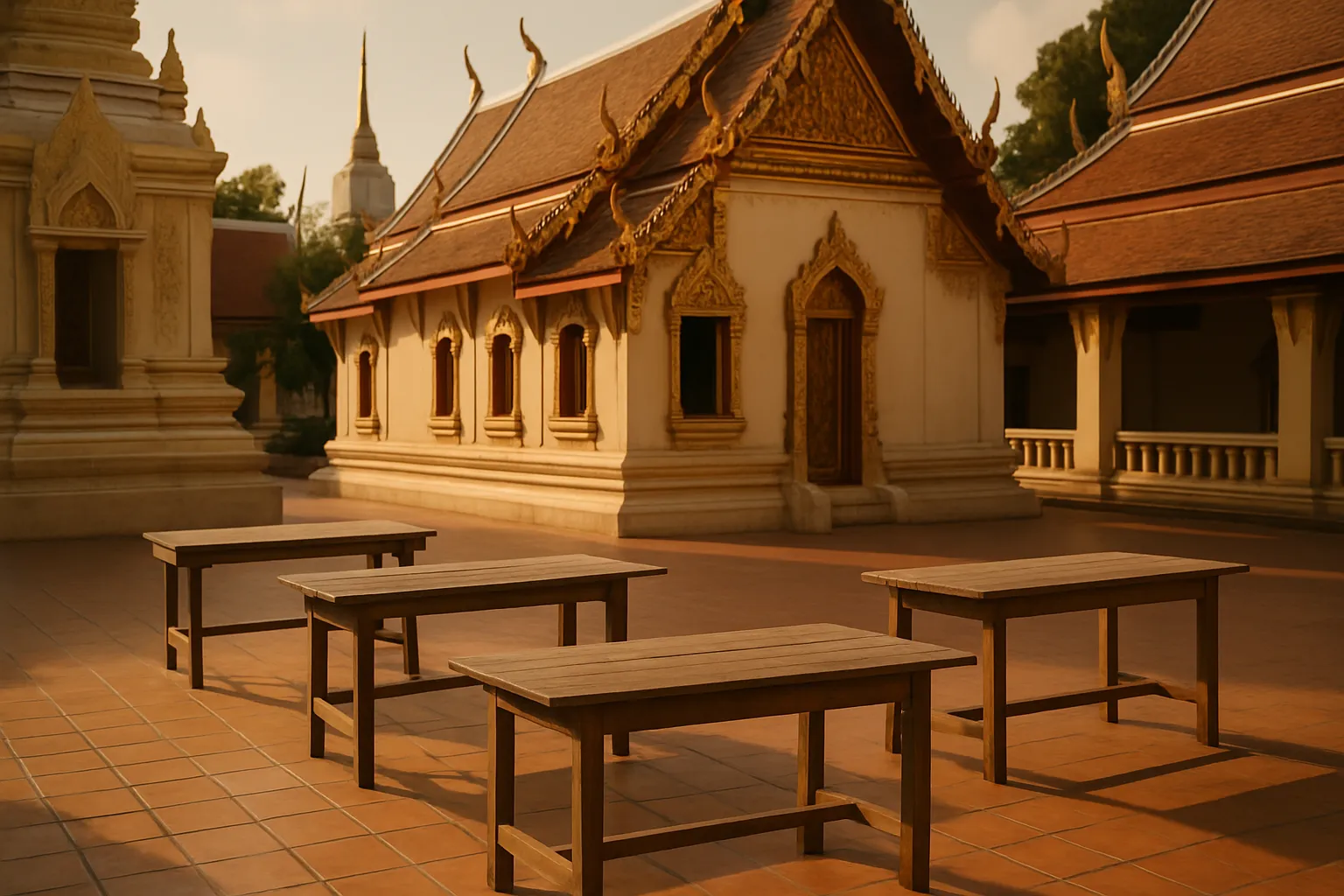
There is a market in Thai amulets, large and sophisticated, and it is unlike any ordinary trade. It has its own vocabulary, its own venues, and its own institutions for judging what is genuine. This guide describes how that world works, as an observer describes a landscape, not as a directory of where to acquire things. It is the market context behind every object introduced in the Amulets 101 guide, reported in the register of journalism rather than guidance.
The Vocabulary
The first thing to understand is that, in Thai, one does not buy an amulet. One rents it. The verb is chao (เช่า), literally to rent or to hire, explained in full in the glossary, and the choice of word is deliberate: a sacred object is not treated as ordinary merchandise passing from owner to owner. The sum that changes hands is spoken of as a bucha (บูชา) price, a veneration price, not a sale price, framing the exchange as an act of respect covered under the practice of bucha.
This is not a euphemism layered over commerce. It reflects a genuine attitude in which the object retains its sacred character regardless of the transaction, and the person merely takes it into their keeping. The language sets the tone for everything that follows.
The Temple Counter
The most authentic source is the temple itself. Many monasteries keep a counter where their current-production editions are offered for modest sums, with the proceeds supporting the temple directly, funding repairs, community work, and the life of the monastery. The batch posters for recent editions are often pinned to the wall behind the counter, documenting what is available and how it was made.
For a newcomer, the temple counter is the plainest window onto the whole tradition. There is no ambiguity about origin, the sum is small, and the connection between the object, the monastery, and the community it serves is visible in the setting itself.
The Dealer Market
Beyond the temple, an established secondary market handles older and rarer pieces. In its physical form it gathers at specialist markets: the celebrated stalls around Tha Prachan in Bangkok, near the amulet district, and provincial markets in temple towns across the country. These are described here as a feature of the landscape, a place where the culture is visible, not as a route to a purchase. For a close look at the largest and best documented of these, see the Tha Prachan guide, which covers Bangkok’s specific market in depth; this article stays at the level of the market as a whole.
Increasingly, that market has moved online. Facebook pages and groups, the LINE messaging app, and Instagram are now the dominant channels, and specialist sellers organize their pages by school, by lineage, or by province, so that a follower of one master or one region can follow the relevant output. The center of gravity of the trade, especially outside the temple counter, is now digital.
Beyond Tha Prachan
Tha Prachan is the market’s center of gravity, but it is not the only physical venue. In Bangkok itself, a smaller amulet market sits behind Wat Ratchanadda, near the Loha Prasat’s iron spires, drawing steady foot traffic despite carrying a reputation for higher prices than Tha Prachan. Chatuchak Weekend Market has amulet vendors as well, though the depth of the offering and the expertise on hand does not match a dedicated amulet district.
Outside the capital, most sizeable towns hold at least an informal weekly market, often timed to fall on a fixed day. Chiang Mai’s Tippanetr market, held on Tuesday mornings in the city’s north, has built a reputation among northern collectors for genuine pieces and dealers who know their stock. Nakhon Sawan holds a Monday market near Wat Photharam, and similar rotating markets appear across the provinces, each drawing its trade mostly from the surrounding district rather than from national buyers. A newcomer gains more from visiting one market repeatedly, watching how the same dealers price and describe the same categories of object week to week, than from touring several markets once each.
Evaluating Sellers Online
Because so much of the trade now happens through Facebook pages, LINE groups, and Instagram accounts, judging a seller’s credibility before any exchange takes place has become a basic skill rather than an optional caution. This is reported here as a description of how experienced buyers read these channels, not as instruction for how to transact.
A page’s history is the first signal. An account with years of consistent posting, a stable following, and a visible record of past listings carries more weight than one created recently or one that posts sporadically in bursts. Sellers who welcome close photographs from multiple angles, who answer specific questions about an object’s phim and provenance without evasion, and who are open to a piece being sent for independent assessment through the association circuit behave differently from those who resist scrutiny.
Pressure is the clearest warning sign the trade itself recognizes: claims that another buyer is waiting, that a price expires within the hour, or that an object is too rare to examine closely first. Thai authorities have prosecuted organizers of amulet-selling Facebook groups for running counterfeit schemes, a reminder that the online channels carry the same fake problem as the physical market, without a market’s shared setting to temper it. The certification circuit described above exists precisely because no seller’s word, online or in person, substitutes for that institutional check.
The Certification Ecosystem
What keeps such a market coherent is a distinctive institution: the certification circuit. Thailand has collector associations that run judged competitions, at which amulets are examined and ranked by panels of experienced experts, the connoisseurs the tradition calls sian phra (เซียนพระ). These panels, described in the glossary, are the recognized authorities on authenticity.

The crucial point is where authority sits. It rests with the associations and their competitions, not with any individual seller’s assurance. An amulet that has been examined and recognized through that circuit carries a standing that a private claim cannot, and this collective, institutional model of authentication is one of the things that makes the Thai field unusual.
Price Tiers
Prices in this world span an enormous range, and the figures that follow are offered strictly as journalism, reported and date-stamped, never as an offer. At a temple counter, a current edition is typically rented for THB 20 to 500 (from under USD 1 to approx USD 14), as of August 2026. Amulets tied to established, still-living monks form the broad middle of the market, commonly THB 500 to 50,000 (approx USD 14 to 1,400), as of August 2026. High-end vintage pieces and kru excavations run from THB 50,000 into the millions (from approx USD 1,400 upward), as of August 2026. At the very top, a canonical Benjapakee amulet can change hands for tens of millions of baht, with Thai press reports citing figures as high as THB 100 million (approx USD 2.8 million), as of August 2026.
Those numbers move over time and are recorded here only to convey the shape of the market, from the pocket-money editions at a temple counter to the rare classical tablets that make national news. The struck coin editions described in the rian guide sit near the accessible end; the Benjapakee occupy the summit.
The Fake Problem
No honest account of this market can omit that copies exist, and at industrial scale. This is stated plainly and without drama, because drama serves no one. Where objects carry high value and deep meaning, imitation follows, and the Thai amulet world has long lived with it.
The response is not paranoia but education and the certification circuit. A student who learns the tradition, and who understands that authority rests with the association panels rather than with any single assurance, is far better placed than one who approaches the field anxiously and alone. Lokavidu’s part in this is education, not adjudication: this site explains how the world works and what its institutions are, and it points authentication toward the Thai associations that do that work.
How a Foreigner Enters
For a newcomer, the sensible path is narrow and slow. Begin at temple counters, where origin is plain and the sums are small. Learn one school, or one monk, thoroughly before branching out, so that knowledge deepens rather than scatters. The glossary and the monk profiles on this site are meant to serve as that curriculum, a way to build understanding before anything else.
That is where this guide ends, deliberately. It has described how the market works, not where to spend, because the aim of this site is a knowledgeable reader rather than a hurried participant. For the wider world these objects belong to, and the tradition that gives them meaning, return to the Amulets 101 guide.