
A Thai temple, or wat, is a working religious space, not a museum, and visitors are genuinely welcome in it. The etiquette can look intimidating from outside, but almost all of it flows from a single principle: the sacred sits high, and you show respect by keeping it that way. Hold that idea and most of the specific rules follow naturally.
The Buildings
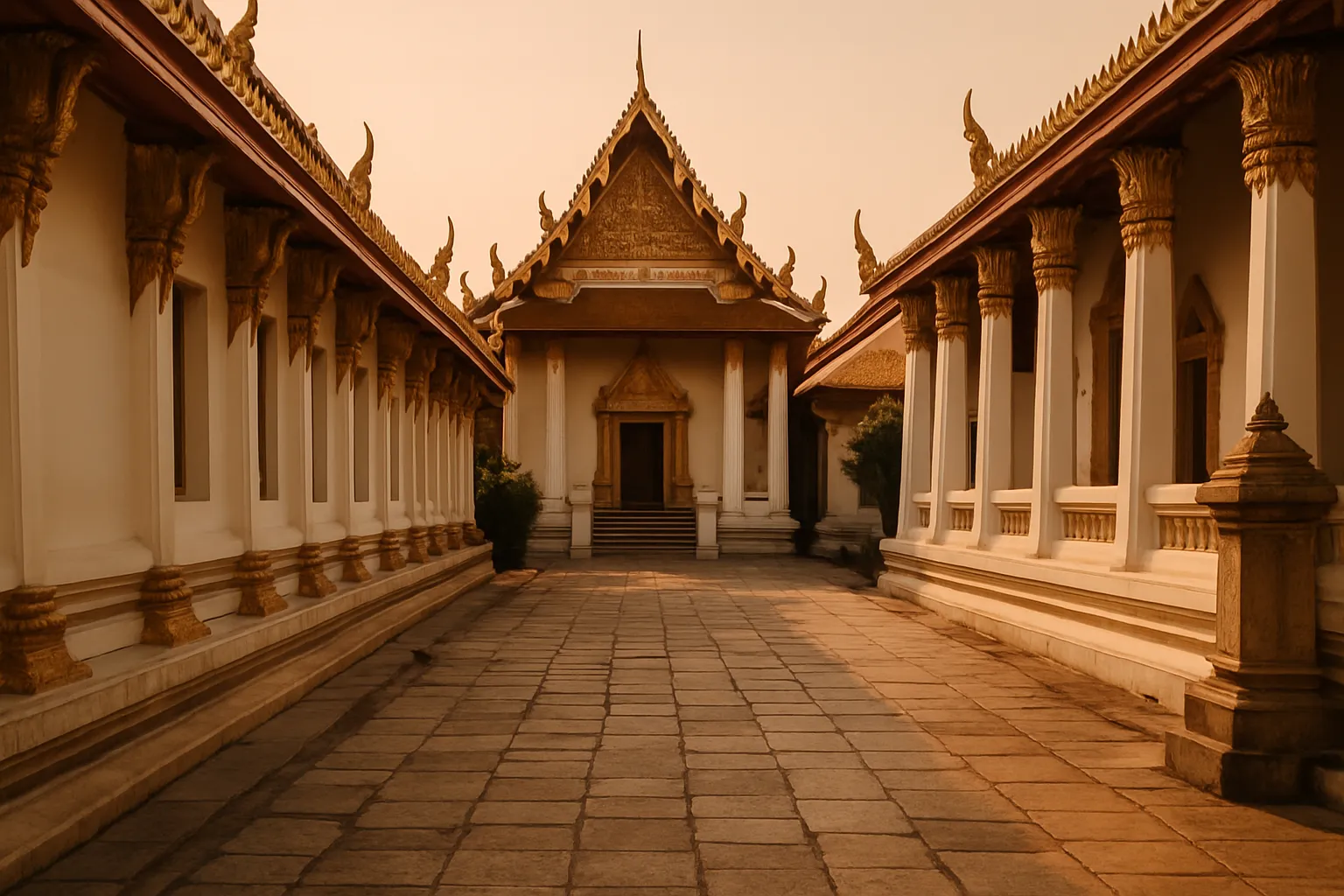
A wat is not one building but a cluster of them, and knowing which is which changes how carefully you behave in each. The ubosot (อุโบสถ), the ordination hall, is the most ritually bounded structure on the grounds. It holds the temple’s primary Buddha image and is where ordinations and major ceremonies such as phutthaphisek take place. It is marked off by eight sema (เสมา) stones, leaf-shaped boundary markers set at the cardinal and intercardinal points, which fix the consecrated ground beneath and around the hall. Some ubosot are open to visitors outside ceremony hours; others are reserved for monastic use, so check before you assume you can enter.
The wihan (วิหาร), sometimes spelled viharn, is the assembly hall. It also houses Buddha images, often the temple’s secondary ones, but it carries no sema boundary, and it is the building most visitors actually spend time in: open for offerings, for sitting quietly, for the general public. A sala (ศาลา) is a smaller, open-sided pavilion used for merit-making events, alms giving, or simply resting; you will find them scattered around larger temple compounds. Kutis (กุฏิ) are the monks’ living quarters, standalone or clustered, and they sit outside the areas a visitor should wander into. Treat them as private residences, because that is what they are.
Dress and Shoes
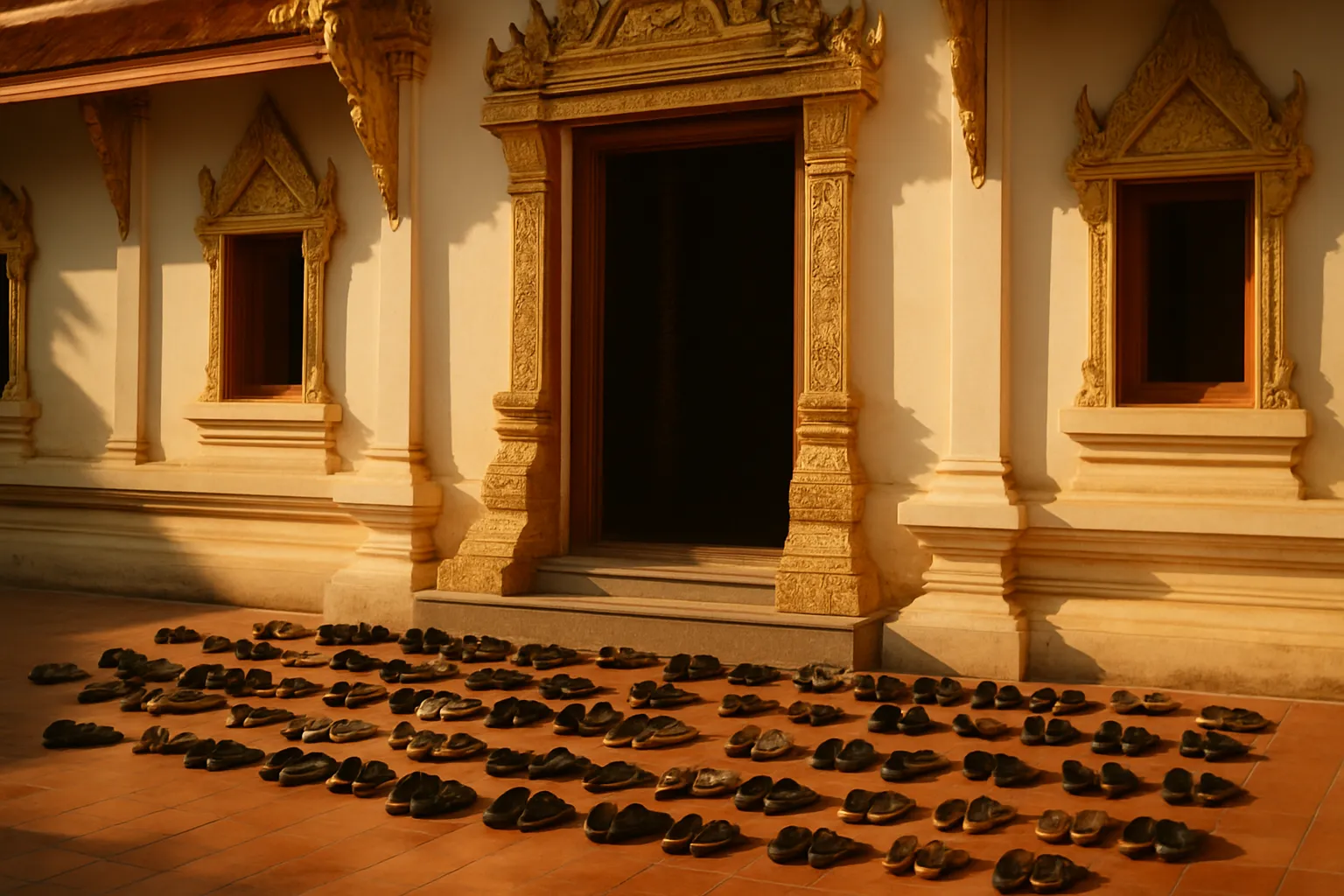
Cover your shoulders and knees. Avoid see-through or very revealing clothing. This applies to everyone, and it is enforced most strictly at the ubosot and wihan, where you may be turned away or asked to cover up or borrow a sarong from the entrance if you arrive underdressed. Shoes come off before you step into any roofed temple building, the ubosot and wihan especially; you will see the racks or a simple pile of footwear at the entrance and can leave yours with the rest. You do not need to remove shoes to walk the open courtyards or approach a stupa from outside, only when you cross the threshold into a hall. Theft from these piles is rare, but if a temple offers a shelf with numbered slots, use it. Socks are generally acceptable where bare feet feel impractical; the rule is about the shoes touching sacred floor, not about feet themselves.
The Body
Thai custom reads the body as a sanctity gradient, with the head the highest and most respected part and the feet the lowest. Nearly all the physical rules come from this. Do not point your feet at a Buddha image or at a monk; when sitting on the floor, tuck your feet behind you rather than stretching them forward. Do not touch anyone on the head. And if you are a woman, do not touch a monk or hand anything directly to him: place the object down, or pass it via a man or a cloth, and he will take it from there. This is not personal; it is part of the monastic discipline.
Offerings
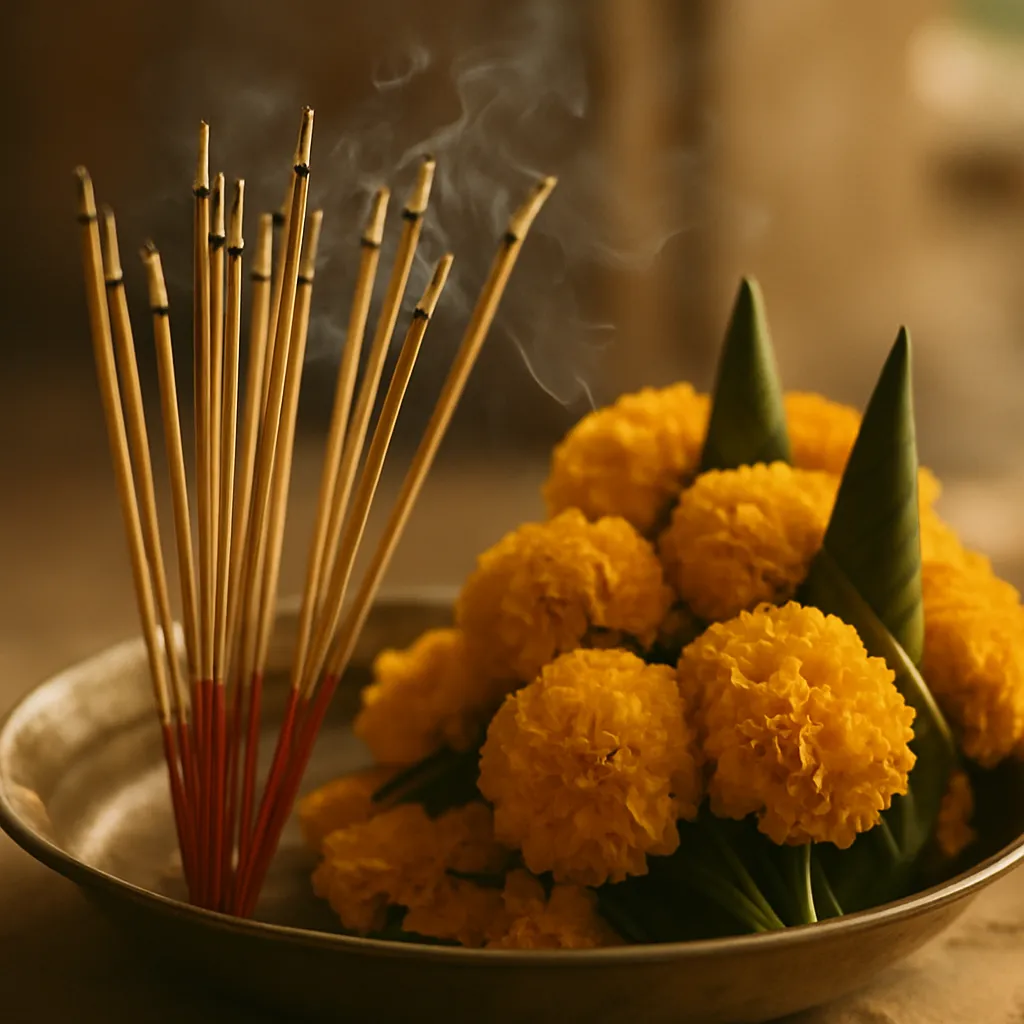
The common offerings are candles, incense, flowers, and small squares of gold leaf. The usual pattern is to light a candle and incense, raise them briefly between your palms in a gesture of respect, place the incense in the sand pot and the candle on the rack, and lay flowers at the appointed spot. Gold leaf is pressed gently onto an image where devotees apply it. To make an offering in this way is bucha (บูชา), the act of reverence, and there is no need to be Buddhist to do it respectfully.
Photography
Photography is usually fine in the open courtyards and around the grounds. Inside the ordination hall, the ubosot, be more careful: look for signs, and ask if you are unsure. Never climb on or pose disrespectfully with Buddha images, and never turn your back to a principal image for a casual photo. When monks are chanting or people are praying, lower your camera and let the moment be.
Walking Into an Active Ceremony
Temples are working buildings, and you will sometimes arrive mid-chant, mid-blessing, or mid-merit-making event with the hall already full of seated people. You are usually still welcome to enter quietly. Remove your shoes at the door as always, keep to the back or sides rather than crossing the room, and sit rather than stand once you are settled, since standing over a room of seated people, including monks, reads as placing yourself physically above them. If you need to pass in front of anyone seated, monk or layperson, lower your body as you go, a slight crouch or a duck of the head is enough, rather than walking past at full height. This is the same sanctity-gradient logic behind the rule on feet: your body should not rise above someone else’s head, particularly a monk’s, in a space built around that hierarchy. To leave before a ceremony ends, wait for a natural pause, gather your things quietly, and exit the way you entered rather than cutting across the room. No one expects a visitor to stay for a full chanting session, and leaving partway through is normal and unremarked as long as it is done without disturbing anyone.
The Morning Alms Round
Before roughly seven or eight in the morning, monks from a nearby wat walk a fixed route on foot, barefoot, carrying an alms bowl, in a practice called tak bat (ตักบาตร), literally “to place into the bowl.” Laypeople wait along the route with food, and the monks receive it in silence and without thanks, since the giving itself is understood to generate the merit, not any acknowledgment returned for it. It is one of the most visible and most commonly witnessed devotional acts in Thailand, and foreigners are welcome both to watch and to take part.
To observe, keep a respectful distance, stay quiet, and do not use flash photography or treat the line of monks as a photo backdrop; a discreet photo from a distance is generally tolerated, a close-up thrust into a monk’s face is not. To participate, buy prepared offerings, usually rice, packaged food, or drinks, from one of the vendors who set up along common alms routes rather than provide something improvised; this keeps the offering appropriate and the monk’s bowl manageable. Kneel or lower yourself as the monk approaches, hold the offering out, and place it into the bowl without letting your hand or the container touch the monk or his bowl directly. The rule on women and monks applies here as everywhere: a woman offers by setting the item down for the monk to lift himself, or passes it through a man, rather than handing it across directly.
The Temple Counter
Many temples have a counter where amulets and other sacred objects are available. In Thai the transaction is described as chao (เช่า), which literally means to rent, a word chosen deliberately so that a sacred object is never spoken of as merely bought. The glossary entry on chao explains the term. It is perfectly acceptable for foreigners to do this, and the temple counter is the most straightforward place to acquire an amulet, since provenance is clear and prices are modest. If you take one home, the wear and care guide covers what to do with it next.
Monks
Monks are addressed with respect and greeted with a wai, the palms-together gesture, which you offer and they need not return. Speak quietly and unhurriedly. Remember the rule for women above: nothing handed directly, whether at the alms round, at the temple counter, or anywhere else on the grounds.
At a Cremation or Shrine
Many wat compounds include a crematorium and a hall used for funeral rites, and a foreigner may find themselves at one, invited to a friend’s or colleague’s family funeral, or simply present when a service is underway. The dress code tightens here: black, white, or muted, subdued colors are expected, never bright colors and never red, which reads as festive rather than solemn. Modest, fully covering clothing applies as strictly as it does in the ubosot. A quiet wai to the family on arrival is customary and appreciated. Foreigners are usually welcome to sit in on the chanting and the cremation itself, but should follow the lead of those around them rather than initiate any part of the ritual, and photography of the ceremony itself is not appropriate. If a shrine or spirit house on the grounds is receiving offerings from a Thai visitor nearby, the same posture applies as inside a hall: keep your own body low relative to anyone in an act of devotion, do not step between a devotee and the image or shrine they face, and photograph only from a respectful distance if at all.
Being Human About It
None of this needs to be nervous or perfect. Thais notice and appreciate visible effort, and small mistakes are forgiven instantly when the intent is plainly respectful. Watch what those around you do, follow their lead, move slowly, and keep the one principle in mind: the sacred sits high. Do that, and you will be a welcome guest in one of the calmest and most generous public spaces Thailand has to offer.
Where to Go Next
The glossary entry on wat covers the structure of a Thai temple as an institution, and the entry on chao explains the renting convention behind the temple counter in more depth. Once you have brought something home from a temple visit, the wear and care guide covers what to do with it next.