
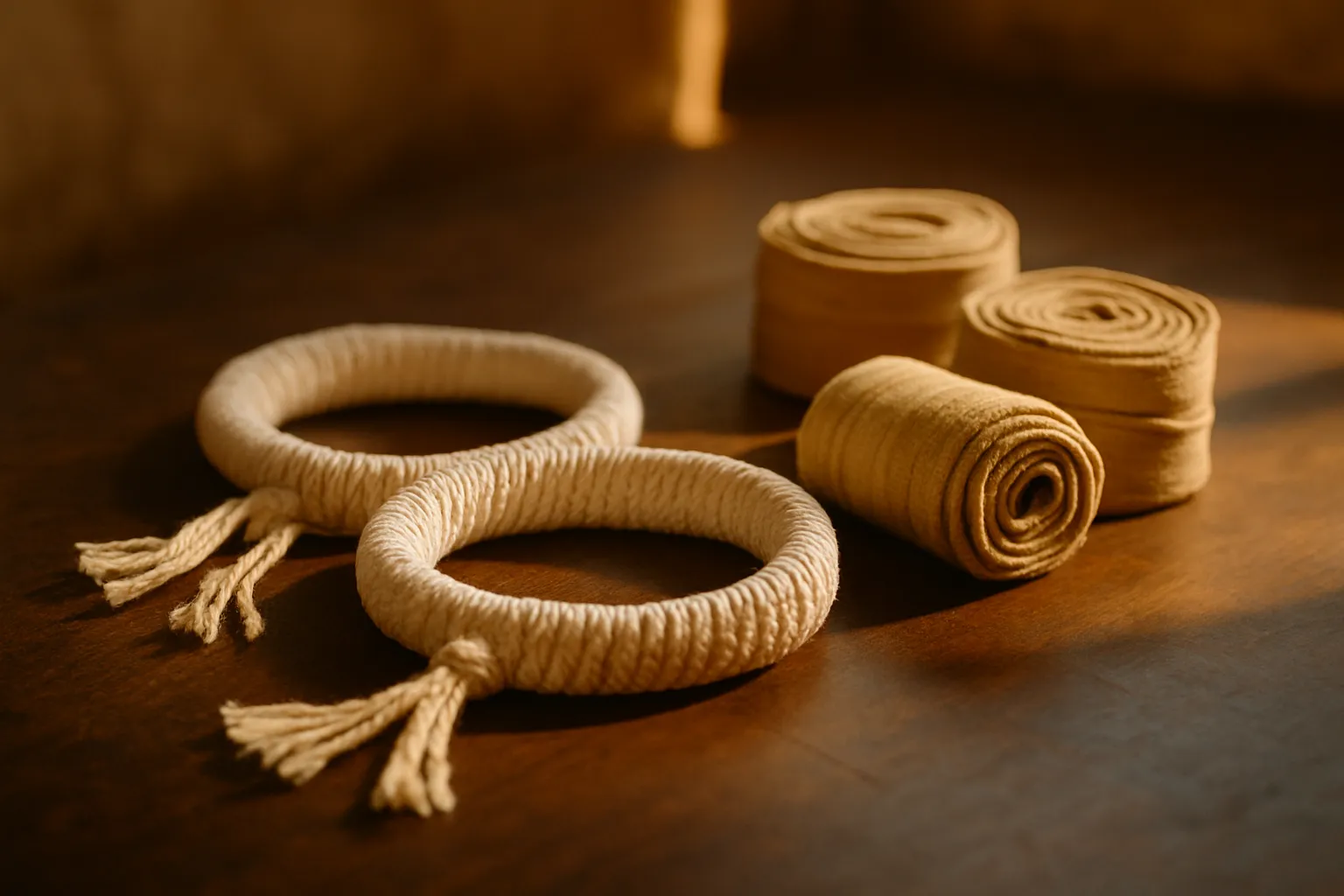
For many people outside Thailand, a muay thai fight is the first place they ever see the consecrated-object tradition in action. The headband, the armbands, the tattoos, and the slow dance before the bell are not stagecraft. They belong to the same sacred world as the amulet, and they carry the same logic of blessing and protection. The Amulets 101 guide covers the objects in general; this article looks at how that world appears in the ring.
Wicha and the Fighter
Sacred knowledge and fighting have been intertwined in Thailand for centuries. Fighters have long sought blessings from monks and masters before a bout, in much the way soldiers once sought them before battle. The concerns are the same: to be protected, to be steadied, and to carry the presence of a teacher into a dangerous moment. What surrounds a modern boxer is a living remnant of that older bond between martial life and the sacred arts.
The Kai Muay: Gym as Lineage
A fighter’s sacred objects rarely belong to the fighter alone. The mongkol in particular is understood to carry the collective standing of the kai muay (ค่ายมวย), the gym or camp that trained the fighter, and it is common for every fighter from the same camp to wear a mongkol of the same design. This is the same logic of lineage that runs through the wider consecrated-object tradition, where an amulet edition is read against the temple and the master monk who produced it. In muay thai the temple’s place is taken by the kai muay: a training lineage of head trainer, the trainers before him, and the fighters who carried the camp’s name before the current generation stepped into the ring.
The wai khru ram muay makes this lineage explicit. Before the dance itself, a fighter typically kneels and bows three times, a gesture directed in turn at parents, at teacher, and at the Buddha. The bow to the teacher is understood to reach backward through the whole chain of instructors who trained him, not the immediate trainer alone. A fighter who has changed camps over a career may carry more than one lineage into that bow, and gyms with a long competitive history, the kind that have supplied fighters to Lumpinee and Rajadamnern stadiums for generations, treat that inherited standing as part of what the mongkol on a young fighter’s head represents.
The Mongkol
The most recognizable object is the mongkol (มงคล), the sacred headband worn into the ring. It is woven, traditionally from sai sin, the consecrated cotton thread, and blessed by a master before it is given. The fighter wears it during the pre-fight ceremony, not during the fight itself: it is removed before the boxing begins and placed in an elevated position in the corner, because a blessed object is not meant to be worn while blows are exchanged. The glossary entry on the mongkol sets out its role, and the entry on sai sin explains the thread it is made from.
The Pra Jiad
The pra jiad (ประเจียด) are the armbands, and they behave differently from the headband. Where the mongkol is removed, the pra jiad remain on the upper arms throughout the fight. They too are blessed by a master and are understood as protective amulets in cloth form, worn close to the body through every round. The glossary entry on the pra jiad gives the detail.
Sak Yant in the Ring
Many fighters also carry sak yant (สักยันต์), the sacred tattoos tapped into the skin by a master and empowered with katha. Worn for protection and empowerment, they are most commonly placed across the back, where the large protective designs have room to sit. Unlike the headband and armbands, the yant is permanent, carried in the skin itself. The sak yant pillar treats the tradition in full.
Amulets at the Neck
Alongside the tattoos and the cloth, fighters often wear amulets in the ordinary way, typically at the neck. These are usually removed before entering the ring, for the same reason the mongkol is set aside, but they are worn during training and through daily life. For a boxer, the amulet is part of the same continuous practice of respect and protection that the ceremony makes visible on fight night. Amulets are rented, not bought, chao (เช่า) rather than purchased, a convention that keeps consecrated objects outside ordinary commerce even when a fighter’s neck amulet has real market value among collectors. For guidance on wearing and caring for amulets outside the ring, see Wearing and Caring for Thai Amulets.
The Wai Khru Ram Muay
Binding all of this together is the wai khru ram muay, the dance performed before the fight. It pays respect to the fighter’s teacher and lineage and invokes protection for what is about to happen. The glossary entry on wai khru describes the wider custom of honouring one’s teacher, of which the ring dance is the most public form. Watching it, an outsider is really watching the amulet world express itself in movement: teacher, blessing, protection, and respect, all enacted before a blow is thrown.
Fighters personalize the dance within its fixed frame. Buakaw Banchamek, one of the sport’s best-known modern names, performed a version built around an archer’s motion, drawing an imagined bow and stamping down as though releasing the arrow at his opponent. The gesture is his own addition, but it sits inside the same three-part structure every fighter follows: circling the ring, kneeling to the teacher, and the dance itself.
Regional Variation in the Ram Muay
The ram muay is not one fixed choreography. It carries the imprint of the regional styles that produced modern muay thai, the way a temple lineage shapes the phim and muan sarn of an amulet edition even within a shared consecration tradition. A Thai saying summarizes the old regional schools: hard punch from Korat, wit from Lopburi, posture from Chaiya, and speed from Thasao, four provincial styles that each developed distinct stances, footwork, and rope-wrapping methods before the sport standardized into the modern ring.
Muay Chaiya, from the south, shows the clearest link back to the sacred-object tradition itself. Its practitioners traditionally wore headbands and armbands woven from salu, a talismanic cloth distinct from the plain sai sin thread used elsewhere, and its wai khru sequence draws on movements associated with animals, deities, and figures from Thai legend, performed differently by Buddhist and Muslim fighters within the same southern school. A Muay Korat fighter’s wide swinging punch, called mahd wiang kwai, buffalo-throwing punch, and a Chaiya fighter’s tight, elbows-out guard both survive today less as competitive necessity and more as regional inheritance, visible in how a fighter from a given lineage carries the dance before the bell.
Women, the Ring, and the Mongkol
The sacred-object customs around muay thai intersect with gender in ways that have shifted over time. Traditional practice held that a woman entering the ring should pass under the bottom rope rather than climb over the top, on the reasoning, common across the wider Thai body-hierarchy of head as highest and feet as lowest, that nothing should pass above a space holding blessed objects. Some stadiums, including Lumpinee and Rajadamnern in Bangkok, held to a longstanding restriction on women fighting in the main ring itself, a policy that has eased only gradually and unevenly across venues.
The mongkol carried a parallel restriction: for much of the twentieth century, women were commonly held not to wear one, out of concern that doing so would compromise its blessing. That view is no longer universal. Many gyms and trainers today have women fighters wear the mongkol during the wai khru ram muay exactly as men do, treating the object’s protective and lineage-carrying role as belonging to the fighter rather than to gender. Where older stadiums and older trainers still hold the traditional line, the site records the custom as what it is: a living disagreement inside the tradition, not a settled rule.
For the International Muay Thai Community
For the global muay thai community, these objects are frequently the first doorway into a much older tradition. A student who trains in Thailand, receives a mongkol, or sits for a yant is stepping, often without realizing it, into the same world of consecrated objects that produced the amulet. Understood that way, the ring is not separate from the temple. It is one of the places where the tradition is still most vividly alive, and for many people abroad it is where the whole subject begins.