
Most Thai amulets show a Buddha or a revered teacher looking out at the world. One important class does the opposite. The Phra Pidta (พระปิดตา), the “closed-eyes” or “covered-face” Buddha, shows a plump seated figure raising its hands to cover its own eyes, and often its ears and other openings besides. It is one of the most beloved forms in the whole family of Thai consecrated objects, the phra khrueang (sacred objects worn on the body), and its gesture carries a specific and deliberate meaning.
The Meaning of the Sealed Senses
The Pidta’s covered face is a teaching rendered as a posture. In the Buddhist analysis of experience, suffering enters through the sense doors: the eye, the ear, the nose, the tongue, the body, and the mind. The Pali canon repeatedly enjoins the guarding of these doors, a restraint the texts call indriya samvara, watchfulness at the six points where the world floods in.
The Phra Pidta makes that restraint visible. By closing its own senses, the figure models the withdrawal of attention from craving and disturbance, the sealing off of the channels through which harm arrives. Devotees hold that this same sealing works protectively for the wearer: a figure that has shut the doors against the world is understood to shut them against misfortune, ill will, and the words of enemies as well. The tradition reads the gesture on two levels at once, as a lesson in the mind’s discipline and as a shield.
A related, more folk telling of the same idea describes thawan thang kao (ทวารทั้งเก้า), the nine doors of the body: the two eyes, two ears, two nostrils, the mouth, and the two organs of excretion. Sealing all nine stands for a mind withdrawn completely from disturbance, and it explains why the Pidta form is not uniform. The common type raises both hands to cover only the eyes; other versions extend the gesture across the whole face, and a smaller class covers the ears as well, read by tradition as a figure that has shut every one of the nine doors at once. The variants differ in how completely the seal is shown, not in the claim behind it.

The Great Traditions
Two traditions in particular gave the Phra Pidta its stature.
The first belongs to Luang Pu Toh of Wat Pradu Chimplee, Bangkok, one of the most revered abbots of the twentieth century. Born around 2429 BE (1886), he took full ordination in 2450 BE (1907) at age twenty and went on to lead his temple as abbot for sixty-eight years, until his death in 2524 BE (1981). His standing rested first on the depth of his samadhi (สมาธิ), meditative absorption, a reputation that made him one of the most sought-after monks to preside over consecrations of other masters’ work as well as his own. Among the many objects associated with him, the Phra Pidta is regarded as his signature piece, his วัตถุมงคลเอก or foremost sacred object, and his versions of the form are treated by devotees as reference points for the whole type. A fuller account of his life and his other editions is in his monk profile.
The second is southern, and older in spirit. In the province of Phatthalung stands the ritual academy known as Khao Or (เขาอ้อ), a lineage famous for its mastery of protective magic. Its Pidta tradition is tied above all to Ajahn Pal Palathamo (อาจารย์ปาล ปาลธมฺโม), the last figure selected through the academy’s traditional teacher-to-disciple succession. He trained under the academy’s founding patriarch Ajahn Thong Thao from boyhood and became abbot of Wat Khao Or two years after his teacher’s death, a tenure that lasted until his own death in 2521 BE (1978). Ajahn Pal was known for nit chee phet (นิ้วชี้เพชร), the “diamond finger” technique, one of the school’s most closely guarded specialties, and among his lay students was the police officer Khun Phan, remembered across the south as a lawman who investigated cases involving black magic. The Khao Or Pidta is associated above all with maha ut (มหาอุด), the power of invulnerability, classically described as the force that makes a gun fail to fire, a domain closely related to what the tradition elsewhere calls kongkraphan (คงกระพัน). Metal versions from this school were traditionally cast in molds carved from cuttlefish bone, an old technique for shaping alloys of lead, tin, and silver mixed with sacred herbal powder. The Khao Or academy guide covers the school’s wider ceremonial life in full.
Classic Phim of the Phra Pidta
Because the Pidta is a design carried by many masters rather than a single mould, collectors read it through named editions, or phim (พิมพ์), tied to a specific maker and year, much as they would for any other type.
Pidta Metta Mahasaneh, made by Luang Pu Toh in 2518 BE (1975), is compact and pressed from lai lan powder, and its name, roughly “loving-kindness and great charm,” reflects the domain devotees associate with it: goodwill, favor, and success in dealings with other people. Pidta Maha Lap Jumbo, cast in 2520 BE (1977) to mark Luang Pu Toh’s ninetieth birthday, is larger than his other Pidta and was produced in three separate powder mixtures for the same batch, lai lan, gesorn, and somdej powder, a detail that lets specialists distinguish sub-varieties within the single Jumbo edition. Devotees hold that strands of Luang Pu Toh’s own hair were worked into some of his Pidta, a claim reported here as part of the devotional record rather than a documented fact.
From the south, the Pidta Maha Ut associated with Ajahn Pal Palathamo is the reference edition of the Khao Or school’s closed-eye tradition, prized above all for the maha ut claim attached to it rather than for a single fixed appearance, since Ajahn Pal produced the form across his working life in more than one material and casting.
Powder, Herb, and Metal
Like most amulet forms, the Phra Pidta exists in more than one material, and its material shapes both its character and how it is worn.
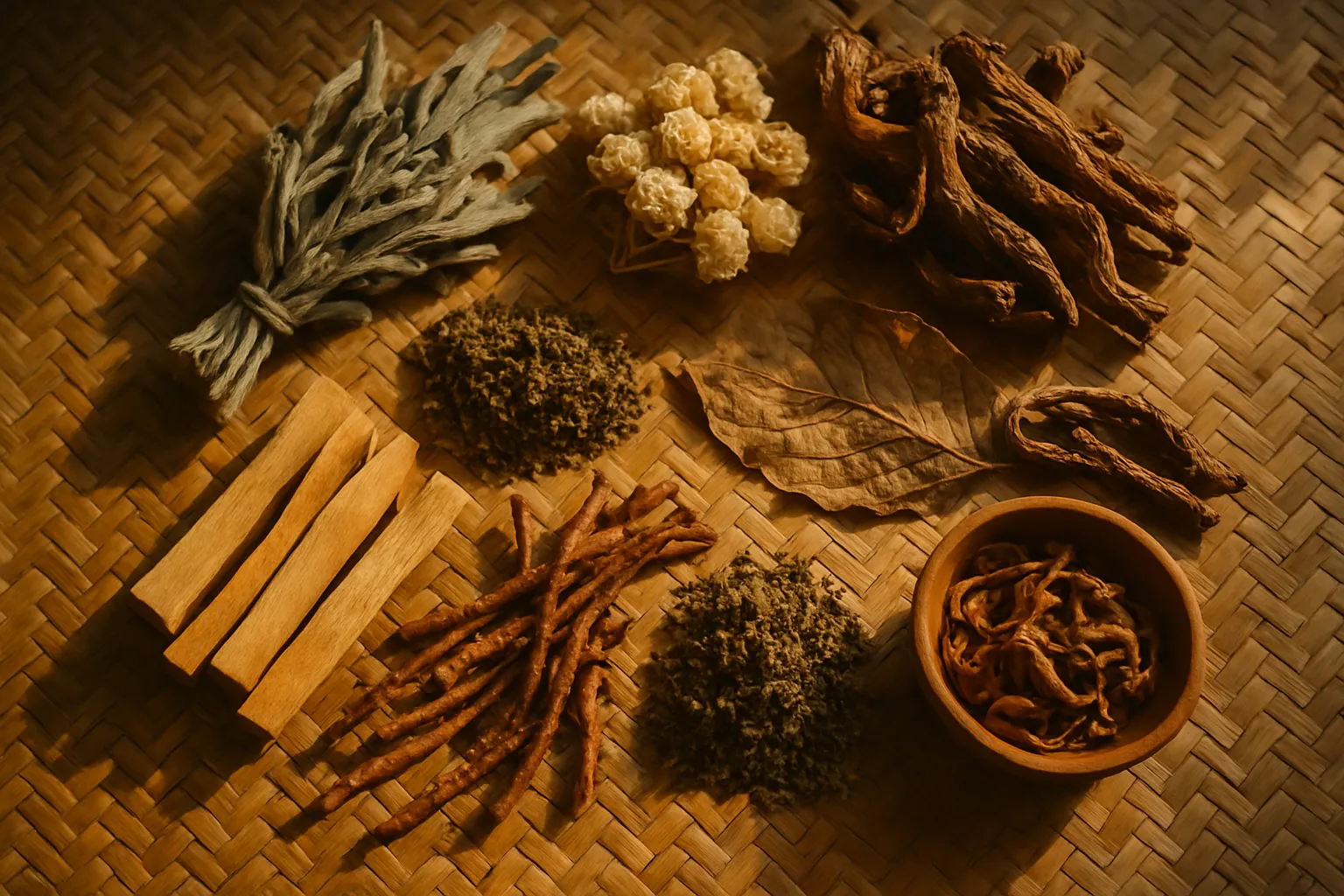
Powder Pidta are pressed from sacred powder compounds in the manner of other molded amulets, and a single master’s output often mixes several powder recipes across different batches of the same edition, as with Luang Pu Toh’s Jumbo pieces above. Herbal Pidta, built from compounded sacred plants, the class collectors call nuea wan (เนื้อว่าน), are especially associated with the southern lineages, where the gathering and mixing of potent herbs is central to the craft; the Khao Or school’s wan 108 blend, one hundred and eight herbs gathered under prescribed lunar conditions, is the best known example. Metal Pidta are cast, sometimes in mixed sacred alloys such as the nawaloha nine-metal blend, and carry the durability of metal against daily wear where a powder or herbal piece would eventually wear down or crack. A smaller class is worked in fired clay, closer in body to the earliest kru-find amulets than to the powder and metal traditions that dominate the type today. Whatever the body, the object is brought to life through consecration and the recitation of the proper katha (the incantations that accompany the rite), without which, in the tradition’s eyes, it remains only a well-made figure.
What Devotees Seek From It
Every amulet form has a reputation, a domain of life it is understood to serve, and the Phra Pidta’s is protection in its broadest sense. Devotees turn to it for invulnerability of the body, for shelter from accident and violence, and, in a register particular to this form, for defense against slander, envy, and the ill will of other people. A figure that has closed its own eyes is held to deflect the harmful gaze and the harmful word alike.
Traders and shopkeepers make up a large part of the Pidta’s following as well, drawn to the metta mahaniyom (เมตตามหานิยม) side of its reputation, goodwill and favor in dealings with other people, which devotees connect to steady trade and good fortune in business. That combination, protection for the body and goodwill in ordinary dealings, is part of why the form crosses so many kinds of wearers, from soldiers and police to merchants and office workers.
As with every object on this site, Lokavidu reports these as the claims of the tradition that makes them, attributed to the devotees and teachers who hold them, and neither promoted nor dismissed. What can be stated plainly is the history: two great lineages, one in Bangkok and one in the southern hills, that raised a small covered-face Buddha into one of the most trusted images a Thai person can wear.
Where to Go Next
The Phra Pidta sits within a much larger world of consecrated objects. The Amulets 101 guide explains how these objects are made, blessed, and worn, and the glossary unpacks the vocabulary a reader meets at every turn.