
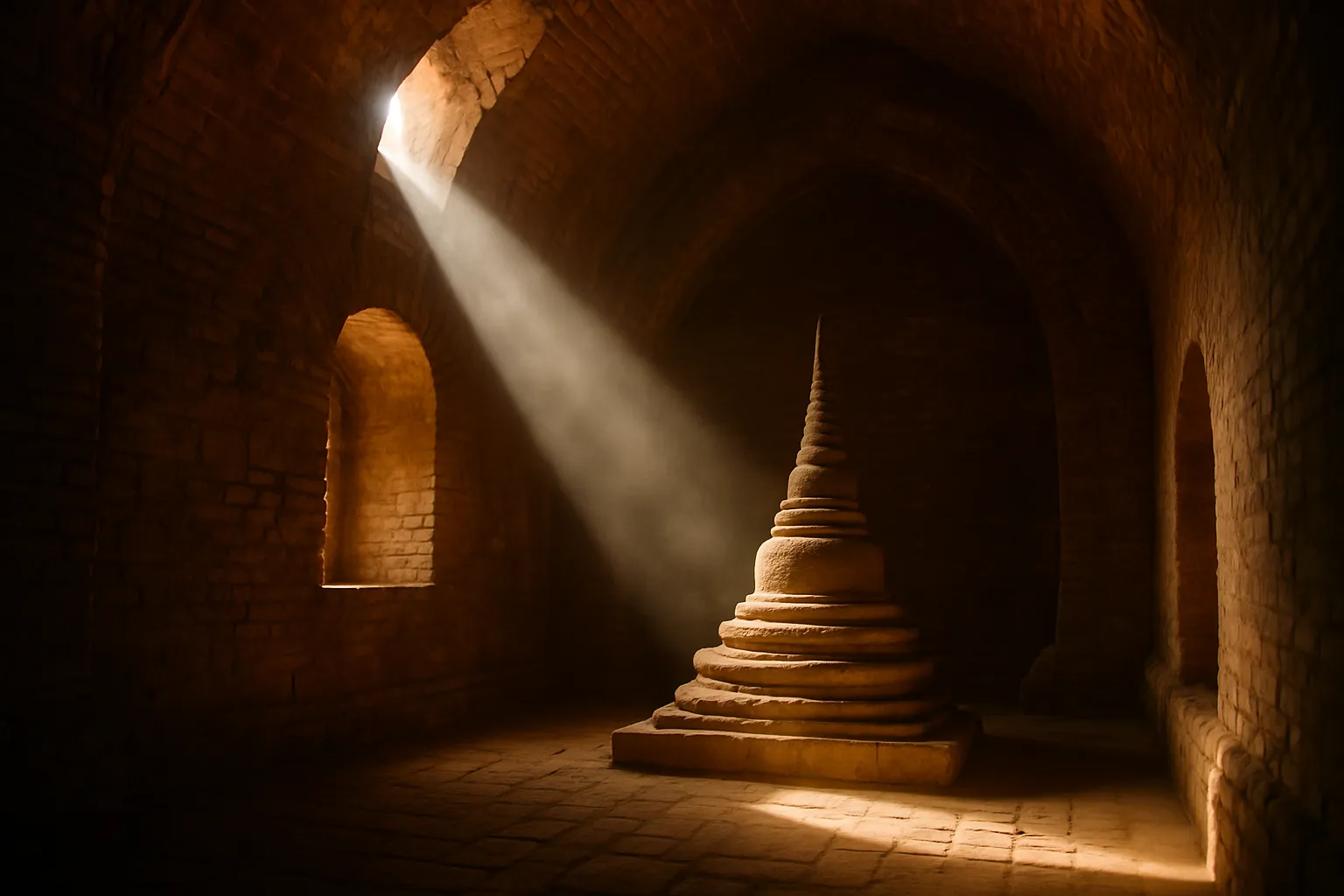
Some of the most revered Thai amulets spent centuries in darkness before anyone wore them. They were not lost. They were placed, deliberately, inside sealed chambers built into temple structures, and left there by the people who made them. The Thai word for such a chamber is kru (กรุ), and it is one of the most important concepts in the whole tradition, because a kru is not only a place. It is a certificate of age, and it stands behind many of the objects introduced in the Amulets 101 guide.
What a Kru Is
A kru is a sealed chamber inside a stupa, a chedi, or another temple structure, in which votive tablets were deposited as merit objects. The tablets, small molded images of the Buddha, were made in quantity and then walled up inside the monument, sometimes hundreds of years ago. The glossary entry on the kru gives the term in brief; the fuller story is why anyone would seal sacred images away where no one could see or venerate them.
The answer is that the burial was itself the act of devotion. To place thousands of Buddha images inside a stupa was to make an enormous offering of merit and, at the same time, to plant the religion in a form that could survive the centuries. The tablets were not hidden so much as entrusted to the future.
Why They Were Sealed
The reasoning rests on a traditional teaching that the Buddha’s religion would endure for five thousand years and then decline. Buildings would fall, monasteries would empty, and the living transmission of the teaching, the sangha, would fade. Against that long horizon, images sealed inside a solid stupa would outlast the collapse of the structures around them and preserve the presence of the Buddha through the lean centuries to come.

Seen this way, the kru is an act of faith projected across time. The makers did not expect to benefit from the tablets themselves. They were making a deposit for a distant future, so that when much else had crumbled, the sacred image would still be there, waiting inside the stone.
How a Kru Is Opened
The chambers were meant to stay sealed, and yet they open. Sometimes the cause is pious: a restoration project repairing an old stupa uncovers a chamber and its contents. Sometimes it is accident: an earthquake cracks a monument, or flooding undermines it, and tablets spill out. And sometimes it is theft, with treasure hunters breaking into a chedi in search of what is inside.
The history of kru openings is therefore a mix of reverent discovery and outright looting, and the two are not always easy to tell apart after the fact. A famous find may have entered the world through careful temple restoration or through a hole knocked in a wall at night. This uncomfortable duality sits at the origin of some of the tradition’s most treasured objects, and honesty requires naming it.
Famous Kru Finds
The importance of the kru is clearest in the amulets that came out of specific ones. The five canonical tablets known as the Benjapakee, the subject of their own pillar guide, are all kru discoveries. Phra Rod came from the crypt at Wat Mahawan in Lamphun. Phra Phong Suphan emerged from temples in Suphan Buri. Phra Sum Kor was found at Kamphaeng Phet. Nang Phaya came from Wat Nang Phaya in Phitsanulok.
Each of these is defined, in part, by the chamber it came from. The tablet and its kru are inseparable in the way collectors and devotees speak of them, so that naming the amulet and naming its crypt are almost the same act.
It is worth noting what these four have in common and what sets the fifth apart. Four of the five canonical Benjapakee tablets are kru discoveries, excavated from sealed chambers after long centuries underground. The fifth and most famous, Phra Somdej, is not: it was made in the nineteenth century by the revered Somdej To and belongs to the living tradition of named production rather than to the crypt. That the most celebrated set in the whole field is split in this way, four excavated and one made, captures in miniature the double nature of the amulet world.
Documented Openings
Two episodes show the range between reverent discovery and outright looting.
In 2392 BE (1849), the monk who would become Somdej Toh of Wat Rakhang, Bangkok, traveled to Kamphaeng Phet to visit relatives. There he found an inscribed stone recording an old chedi on the bank of the Ping River. He had the site surveyed, located three ruined chedis, and opened them to find quantities of Phra Sum Kor tablets, one of the five Benjapakee, along with an inscription describing the method of their making. The find was documented, credited to a named monk, and folded into the historical record of the amulet itself. This is the reverent end of the spectrum: a monk of standing following a written clue to a sanctioned opening.
The Ayutthaya crypt at Wat Ratchaburana shows the other end. In 1957, thieves broke into the sealed crypt beneath the temple’s central prang, apparently reasoning that if the neighboring Wat Mahathat excavation of 1956 had produced gold, the same royal-era temple across the road might hold similar treasure. They were right: the crypt held an estimated 100 kilograms of gold regalia, Buddha images, and votive tablets, along with mural paintings among the oldest surviving examples of Ayutthaya-period temple art. Police caught the thieves and recovered part of the haul; the following year the Fine Arts Department carried out a proper excavation, and the recovered objects are now held at the Chao Sam Phraya National Museum in Ayutthaya. The 1957 break-in is one of the best-documented kru lootings in the country’s history precisely because it triggered an official response.
Restoration and Official Handling
Modern temple restoration has become the more common route by which a kru now comes to light, and the process looks nothing like the freelance openings of earlier centuries. When Wat Prayoon in Bangkok undertook a major restoration of its chedi between 2549 and 2553 BE (2006 and 2010), engineers working with the Fine Arts Department uncovered two previously unknown crypts inside the structure. The relics recovered were catalogued and placed on public display at the temple rather than dispersed into the collector market.
That pattern, restoration uncovering a chamber that a government department then documents and controls, is now the norm at any temple recognized as a heritage site. It replaces the older pattern of a chance opening followed by informal, undocumented distribution of whatever was inside.
Legal Status
Kru finds do not belong to whoever opens them. Under the Act on Ancient Monuments, Antiques, Objects of Art and National Museums, B.E. 2504 (1961), buried antiques are the property of the Thai state, and excavation within the grounds of a registered ancient monument requires a permit from the Fine Arts Department’s Director-General. Unauthorized digging is an offense under the same act, carrying fines and potential imprisonment.
This is part of why the provenance of an older kru amulet matters so much to the market: an object with a documented, department-sanctioned excavation history sits on firm legal and evidentiary ground, while one that surfaced through an undocumented dig carries a murkier past that no amount of phim study can fully resolve.
The Kru as Authentication
This is why the kru matters far beyond archaeology. An amulet’s kru of origin is its provenance. To say a tablet is from “kru Wat Mahawan” is not merely to give a location; it is to make a claim about the object’s antiquity and lineage, tying it to a documented discovery from a known site. The kru functions as a certificate of age.
That claim, of course, is exactly what makes the field difficult, and it is why authentication belongs to the Thai collector associations and their experts rather than to any single voice. Lokavidu describes what a kru is and why it matters; it does not adjudicate whether a given tablet truly came from one. The concept and the verdict are different things, and this site deals only in the former.
Kru Versus Living Production
The kru also marks one of the great dividing lines of the amulet world. Kru amulets are finite. There are only so many tablets in any chamber, no more can ever be made, and once excavated they are traded at the top of the market as the antiquities they are. They belong to the past, and their supply is closed.
Set against them is the living tradition, in which amulets, the sacred phra khrueang (พระเครื่อง) described in the glossary, are made new by the thousands every year and are available for modest sums. Two objects sitting side by side in one tray may thus come from entirely different worlds: one excavated from a centuries-old crypt, the other struck last year at a temple counter. That doubled nature, ancient and contemporary at once, is one of the tradition’s defining features, and it runs right through the Amulets 101 guide.