
The Benjapakee: Thailand's Five Canonical Amulets
Five amulets from five eras define the summit of the Thai collecting world. The Benjapakee is part canon, part curriculum, part aspiration. Here is what each one is, where it came from, and why the five were chosen.
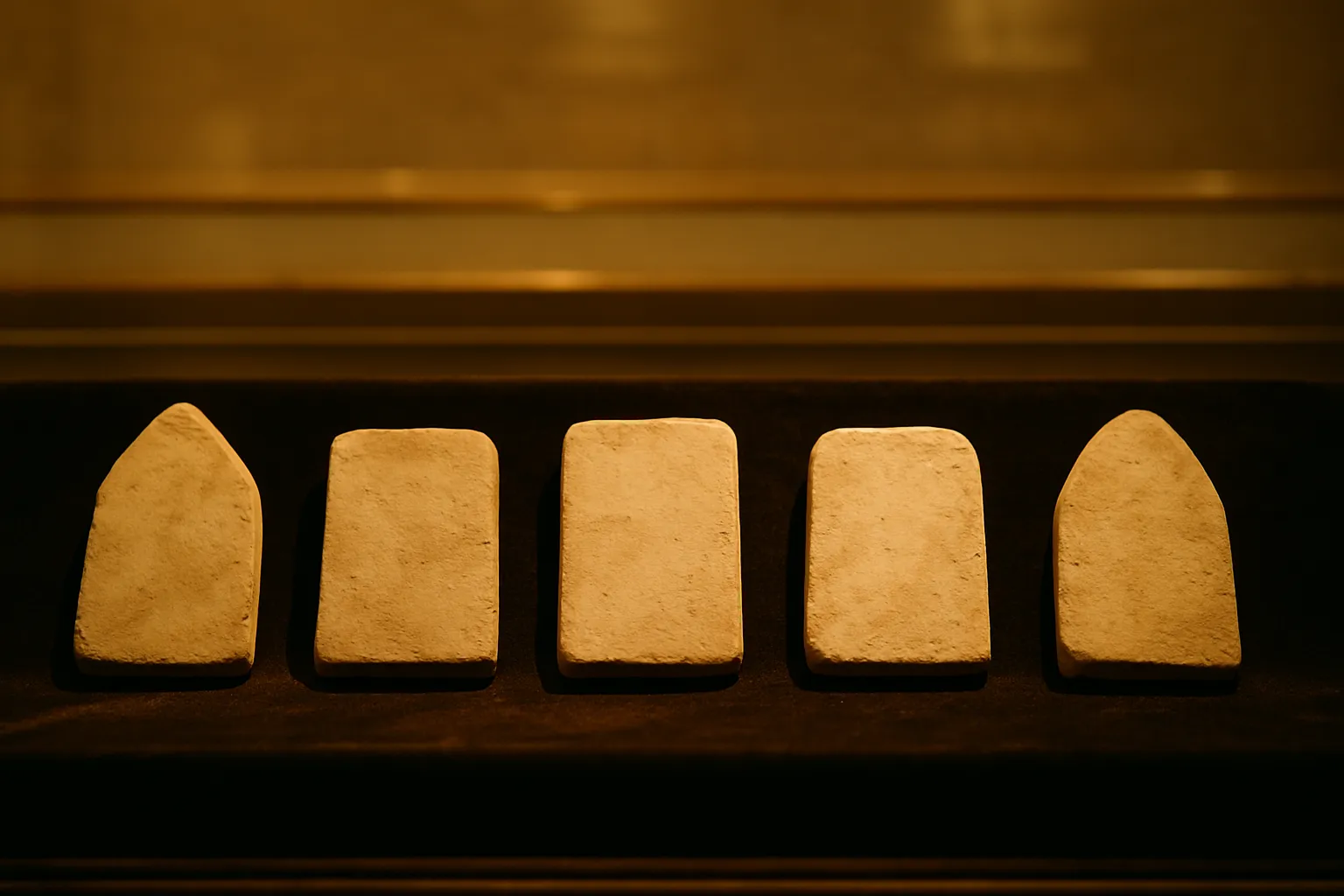
The word means “set of five.” Benjapakee (เบญจภาคี), from the Pali panca (five) and bhagi (shareholder, participant): five amulets that together span the breadth of Thai Buddhist history and sit at the summit of the collecting world. Every serious collector knows the names. Most will never hold a genuine example of even one.
The five are Phra Somdej of Wat Rakhang in Bangkok, Phra Rod of Wat Mahawan in Lamphun, Nang Phaya of Wat Nang Phaya in Phitsanulok, Phra Phong Suphan of Suphan Buri, and Phra Sum Kor of Kamphaeng Phet. They were not chosen by a temple or a sangha council. They were chosen by collectors, and the story of that choosing is itself part of the tradition. What Thai Amulets Actually Are covers the ground floor of the amulet world. This guide covers its ceiling.
Who Made the Canon
The Benjapakee is a collector’s construct, not a doctrinal one, and it has a documented origin. In 2495 BE (1952), Colonel Prajan Kittiprawat, a military officer and amulet scholar known by his pen name Triyampawai, assembled the first formal set. He began with three, a grouping he called the Traipakee: Phra Somdej as the president, flanked by Nang Phaya and Phra Rod. Later he added Phra Sum Kor and Phra Phong Suphan, and the set of five was complete.
Triyampawai did not convene a panel or issue a decree. He built his case in print, across a multi-volume reference work titled Pariattha Thibai haeng Phra Khrueang (ปริอรรถาธิบายแห่งพระเครื่องฯ), an exhaustive study of the leading amulet types that opened with a volume devoted entirely to Phra Somdej, first published in 2495 BE (1952) and revised in later editions through 2497 BE (1954) and 2511 BE (1968). It was in these volumes, not a meeting or a vote, that the ranking took hold: Triyampawai’s evidence, his comparisons of phim and material across known examples, and his standing among collectors did the work that no monastic or civil authority ever performed. The Benjapakee canon exists because a body of published scholarship persuaded a market, one edition at a time.
What made Triyampawai’s selection stick, when other groupings were possible, is the elegance of its organizing logic. Each of the five represents a different era of Thai civilization, and together they trace an unbroken line from the oldest strata of Buddhism in mainland Southeast Asia to the modern Rattanakosin period. Phra Rod stands for the Dvaravati and Haripunchai kingdoms. Phra Phong Suphan stands for the U-Thong period. Phra Sum Kor stands for Sukhothai. Nang Phaya stands for Ayutthaya. And Phra Somdej, the youngest and the most revered, stands for the Rattanakosin era and the living tradition. Five amulets, five eras, five domains of spiritual virtue. The canon is a curriculum compressed into a necklace.
Phra Somdej: The President
Phra Somdej (พระสมเด็จ) is the most famous amulet in Thailand. Its creator needs no qualification among Thai Buddhists: Somdej Phra Phutthachan (To Phrommarangsi) of Wat Rakhang Kositaram in Bangkok, universally known as Somdej Toh, who died in 2415 BE (1872). He is arguably the single most venerated monk in Thai history, and the amulets he made and blessed became the template for the entire modern tradition.
The Phra Somdej is a pressed powder tablet depicting the Buddha seated in meditation under a tiered arch. The material is built from the five sacred powders, pong wiset (ผงวิเศษ), which in the classic recipe are ground from chalk inscribed with yant (ยันต์), sacred diagrams, and katha (คาถา), incantations, written and erased thousands of times so the powder becomes an archive of recitation. Shell powder, temple lime, offering flowers, and other muan sarn (มวลสาร), sacred ingredient compounds, complete the base. The result is a small, pale, dense tablet that feels heavier than it looks.
Why is it the president of the set? The tradition’s answer is that Somdej Toh’s barami (บารมี), his accumulated spiritual merit, was so profound that his amulets carry universal virtue: protection, fortune, loving-kindness, and escape from harm all at once. Collectors say that what the other four specialize in, the Somdej encompasses. It is the amulet of all domains.
At the summit of the market, original Phra Somdej from Somdej Toh’s production at Wat Rakhang are discussed in tens of millions of baht, with the Thai press reporting valuations for the most celebrated examples at THB 100 million (approx USD 2.8 million) and beyond, as of August 2026. These figures belong partly to collector lore and partly to journalism; there is no public sale registry. Meanwhile, tribute editions in the Phra Somdej phim (พิมพ์), design mold, are produced by temples across the country every year, available at temple counters for modest sums. The distance between the two price points is a measure of what one monk’s reputation can do to an object’s perceived value across a century and a half.
Phra Rod: The Oldest
Phra Rod (พระรอด) is believed to be the oldest amulet type in the canon, attributed to the Haripunchai kingdom centered in what is now Lamphun, in northern Thailand. The traditional account connects it to Phra Nang Chamadevi, the legendary first queen of Haripunchai, placing its creation in the late Dvaravati period, roughly the seventh to eighth century of the Common Era. Whether the queen herself commissioned the tablets is traditional history rather than documented fact, but the antiquity of the objects themselves is not in serious dispute. Phra Rod tablets have been dated by art historians to the Haripunchai period.
The name rod (รอด) means “to survive, to escape,” and devotees hold that the amulet’s primary virtue is khlaeo khlat (แคล้วคลาด), the narrow escape, deliverance from danger and mortal threat. Soldiers, police officers, and anyone whose work puts them in harm’s way have historically sought Phra Rod for this reason.
The tablets were found in a kru (กรุ), a sealed cache, at Wat Mahawan in Lamphun. They are small, depicting a seated Buddha in a distinctive posture, and they are made of fired clay, giving them a hardness and durability that helped them survive centuries underground. Multiple phim varieties exist, classified by collectors with the obsessive precision the field is known for, though the details of phim identification belong to the specialist literature rather than to a reader’s introduction.
Phra Rod represents the deepest historical stratum of the Benjapakee. To hold one is, in the tradition’s telling, to hold an object from the time when Buddhism first established itself in this part of the world.

Nang Phaya: The Enigma
Nang Phaya (พระนางพญา) is the most unusual member of the canon. The name means “the queen” or “the noblewoman,” and the tablets were discovered in a kru at Wat Nang Phaya in Phitsanulok, in the lower north of Thailand. Their dating places them in the Ayutthaya period, roughly the fifteenth to sixteenth century.
What makes Nang Phaya distinctive is the image itself. Rather than the standard seated or standing Buddha, the figure on a Nang Phaya tablet is often described as having a flowing, almost feminine quality, a seated figure with an unusual posture and softer lines than typical Buddha images of the period. The name “queen” may reflect this visual character, though its origin is debated. Some scholars attribute it to the legend that the tablets were commissioned by a queen or consort; others treat the name as a collector’s convention that stuck.
The tradition holds that Nang Phaya’s primary domain is metta mahaniyom (เมตตามหานิยม), loving-kindness and personal magnetism, the quality that makes others well disposed and cooperative. It is also credited with invulnerability, kongkraphan (คงกระพัน). Collectors who follow the Triyampawai system note that Nang Phaya represents the Ayutthaya era, the period of Thailand’s greatest imperial power, and that the amulet carries the authority of that age.
Nang Phaya tablets are pressed from a fine-grained clay that takes a distinctive reddish-brown or dark tone after centuries of burial. Like Phra Rod, they are kru objects: finite, excavated, and irreplaceable. There are no new Nang Phaya. There are only the ones that came out of the earth.
Phra Phong Suphan: The Documented One
Phra Phong Suphan (พระผงสุพรรณ) holds a unique distinction among the five. It is the only member of the Benjapakee whose creation is documented in a contemporary inscription. A gold foil plate, a lan thong (ลานทอง), was found alongside the tablets in a kru in Suphan Buri province. The inscription records who commissioned the tablets, what materials were used, and what purposes they were intended to serve: protection, the warding of danger, and the bringing of fortune. In a field where provenance is often a matter of tradition and oral history, Phra Phong Suphan has a written certificate from the era of its creation.
The tablets are attributed to the U-Thong period, the cultural precursor to Ayutthaya, placing them roughly in the thirteenth to fourteenth century. The inscription names the sacred ingredients and describes them as having been made by hermit-sages, rishi, eleven in number, who compounded herbs, minerals, and sacred powders into the tablets and pressed them with the handprint of a senior monk. This is not modern collector lore. This is a primary document from the period.
Three phim varieties are recognized: phim na kae (หน้าแก่, “old face”), phim na klang (หน้ากลาง, “middle face”), and phim na num (หน้าหนุ่ม, “young face”), named for the apparent age of the depicted figure. The material is typically a warm yellow-brown powder, sometimes with a reddish tint, that shows a distinctive lacquer-like coating from centuries of contact with resinous substances in the kru.
The tradition holds that Phra Phong Suphan excels in fortune and wealth, in escape from harm, and in invulnerability. Its documented provenance makes it the Benjapakee’s evidence exhibit: proof that the practice of creating sacred tablets with consecrated materials, sealed in crypts for the preservation of the religion, is not a modern projection onto ancient objects but a documented intention from the time of creation.
Phra Sum Kor: The Wealth King
Phra Sum Kor (พระซุ้มกอ), sometimes romanized as Phra Kamphaeng Sum Kor or simply Phra Kamphaeng, comes from the temples and ruins of Kamphaeng Phet, the ancient Sukhothai-era fortress city in the central-north of Thailand. The name describes the amulet’s design: a seated Buddha under a pointed arch that resembles the Thai letter gor kai (กอ ไก่), the first consonant of the Thai alphabet. “Sum” means canopy or arch; “kor” is the letter shape.
The tablets are dated to the Sukhothai period, roughly the thirteenth to fourteenth century, contemporaneous with what is considered the golden age of Thai Buddhist art. Sukhothai-era Buddha images are renowned for their elegance, and the Phra Sum Kor carries that aesthetic heritage in miniature.
Among collectors, Phra Sum Kor is associated above all with fortune and wealth. A traditional saying runs with it that has passed into the collector’s vocabulary: a phrase to the effect that the possessor will never know poverty. Whether this domain was attributed at the time of creation or accumulated through centuries of devotion is, like most such claims, a question that the tradition does not feel the need to answer. The association is ancient, settled, and universally recognized among collectors.
Phra Sum Kor tablets are kru objects from the ruins of Kamphaeng Phet. Like all the ancient members of the set, they are finite. The kru finds are historical events, each one drawing a fixed number of tablets out of the ground and into the market, after which no more exist.
Collectors classify Phra Sum Kor by phim with the same rigor applied to the other four members of the set. The most prized is phim yai mee konok (พิมพ์ใหญ่มีกนก), “large with kanok scrollwork,” named for the flame-like ornamental border framing the seated Buddha; a companion large variant, phim yai mai mee konok (พิมพ์ใหญ่ไม่มีกนก), lacks that border and is known in the trade as sum kor dam (ซุ้มกอดำ), “black sum kor,” for the dark tone of its clay. Below these sit phim klang (พิมพ์กลาง, “medium”), phim lek (พิมพ์เล็ก, “small”), and phim khanom pia (พิมพ์ขนมเปี๊ยะ), named for its resemblance to a flattened Chinese pastry. All were recovered from Lan Thung Setthi (ลานทุ่งเศรษฐี), “the wealthy ones’ field,” the excavation ground on the western bank of the Ping River in Kamphaeng Phet that gives the tablets their alternate name, Phra Kamphaeng. The clay itself is fine grained and mixed with wan (ว่าน), ground medicinal herbs, and dried flower pollen, a recipe collectors credit for the smooth, almost soft-edged finish that distinguishes genuine examples from later copies.
The Logic of Five
Step back and the architecture becomes visible. Triyampawai chose one amulet from each of five historical eras, spanning approximately twelve centuries from the Dvaravati period to the Rattanakosin. He assigned each a primary domain of spiritual virtue: escape from harm, fortune and authority, wealth, loving-kindness, and the universal whole. And he placed Phra Somdej, the only one made by a named, historically documented individual, at the top, as president of the set.
The result is a canon that works on three levels simultaneously. As history, it traces the entire arc of Buddhism in Thailand. As devotion, it offers a complete inventory of protections. And as collecting ambition, it defines a summit that almost no one will reach, which is exactly what keeps people climbing.
It is worth noting, plainly, that the Benjapakee is a collector’s convention, not a temple’s. No monastic authority ratified the set. No Pali text prescribes it. The concept entered the amulet world through the writing of an enthusiast, and it stuck because it was well made. That does not diminish it. Canons are how communities organize value, and the Benjapakee organizes the Thai amulet world the way the Western art canon organizes painting: by identifying exemplary objects and building a curriculum around them.
The Market and the Mountain
The Benjapakee defines the price ceiling of the Thai amulet world. Genuine examples of the ancient four are traded exclusively among serious collectors at prices that start in the hundreds of thousands of baht and climb into the tens of millions. Original Phra Somdej from Somdej Toh’s production commands the highest reported valuations in the entire field. These are press-reported figures in a market with no centralized exchange; treat them as journalism about a market, not as investment guidance.
Around the genuine articles orbits a vast universe of copies, tributes, and forgeries. This must be stated without drama because it is simply the landscape: copies of all five types exist at industrial scale, and authenticating a claimed Benjapakee piece is a discipline that requires years of study, comparison against reference books, and ultimately the judgment of the Thai certification associations and their competition circuit. Lokavidu does not issue authenticity verdicts, and no one should trust a verdict from a source that lacks the training to give one.
What the Benjapakee teaches a newcomer is not how to acquire its members but how to read the tradition. The five types introduce the essential concepts: the kru discovery, the sacred powder recipe, the role of material and mold, the ceremony that consecrates, the vocabulary of virtue, and the market that prices all of it. Master the Benjapakee as a student and you have the framework for understanding every amulet you will ever encounter.
Where to Go Next
How Consecration Works explains the ritual logic that gives every amulet, Benjapakee or temple-counter, its authority. The wear and care guide covers what happens after an amulet is in your hands. And the glossary defines every term this article introduced, from phim to kru to muan sarn, with the Thai script that makes each one searchable.