
Luang Pu Thuad Amulets: The Complete Guide
The saint of escape from harm, the 1954 Wat Chang Hai originals, and the network of masters who built the largest amulet tradition in Thailand.

Luang Pu Thuad (หลวงปู่ทวด) is the most widely rented amulet subject in Thailand, and has been for more than seventy years. The tradition spans a single origin temple, Wat Chang Hai (วัดช้างให้) in Khok Pho district, Pattani province, and dozens of affiliated temples across the south that have issued their own tributes to the same figure. Unlike the anonymous, centuries-old kru finds that anchor the Benjapakee canon, LP Thuad’s amulets carry named makers, a documented production history, and a traceable chain of consecrating monks. That combination, a legendary saint attached to a datable, well-recorded amulet tradition, is what makes LP Thuad a different kind of object from almost anything else Thai collectors rent, chao (เช่า), the term used because these objects are formally rented rather than bought, a convention that keeps sacred objects outside ordinary commerce.
“LP Thuad” refers to a monk the tradition places in the Ayutthaya period, associated by legend with Wat Chang Hai and with Wat Phra Kho (Phra Kho) further north in Songkhla. The full hagiography, including his birth, his ordination, and his death, belongs to the monk profile, which holds the biography in full; this guide keeps that story to what a first-time reader needs and spends its length instead on what no other English-language source currently covers in depth: how the amulets themselves came to exist, who made them, and how the tradition has continued for seven decades.
The Legend Behind the Amulets
Traditional accounts place LP Thuad in the Ayutthaya period, and hold that he once stepped into the sea, either escaping pirates or crossing on a voyage, depending on which version of the story is told, and turned the surrounding saltwater fresh enough to drink. This single episode does more work than any other in explaining the amulet’s later popularity: it is the founding image behind khlaeo khlat (แคล้วคลาด), escape from harm, the quality devotees attach to LP Thuad above all others. The story belongs to hagiography, the devotional biography a tradition tells about its saints, and is reported here as tradition rather than documented history.
The historical gap matters. LP Thuad the Ayutthaya-period monk and LP Thuad the amulet tradition are separated by roughly three centuries, and nearly everything datable about the amulets belongs to the second half of that gap, not the first. The modern tradition begins precisely: on 18 April 2497 BE (1954), Wat Chang Hai’s abbot created the temple’s first LP Thuad amulets. Everything a newcomer sees in the market today, from the earliest vintage pieces to the newest temple-counter tribute, descends from that single dated event, not from any object the historical LP Thuad is said to have touched.
That founding association with escape from harm explains why the image spread so far beyond collectors. Soldiers, police officers, taxi drivers, and market vendors wear it because the danger they face is specific and constant, and khlaeo khlat is understood to answer exactly that kind of danger. The same logic carries LP Thuad into the ring: muay thai fighters wear him alongside the mongkol and pra jiad described in the guide to muay thai amulets, for the same structural reason soldiers and police do.
The Production Lineage: Ajahn Tim and the Network That Followed
This is the part of the LP Thuad story that scattered English-language coverage rarely gets right, because it is usually told as a simple line of succession at a single temple. The documented record is more interesting than that: it is a network, not a chain, and it runs through at least two temples and several monks who each contributed something specific.
Ajahn Tim Dhammatharo (อาจารย์ทิม ธมฺมธโร). Born Tim Phrompradu on 21 August 2455 BE (1912) in Na Pradu subdistrict, Khok Pho district, Pattani, he was ordained at Wat Na Pradu at twenty, taught the Pali curriculum there through the late 1930s, and was sent to Wat Chang Hai, formally Wat Ratsadon Burana (วัดราษฎร์บูรณะ), as acting abbot in 2484 BE (1941). He held the ecclesiastical title Phra Khru Wisai Sophon. Thirteen years into his abbotship, in 2497 BE (1954), he oversaw the temple’s restoration and, as part of raising funds to build its ubosot, created the first LP Thuad amulets, following what temple tradition describes as a vision. He continued issuing LP Thuad editions at Wat Chang Hai for the following fifteen years, until his death from digestive tract cancer on 30 November 2512 BE (1969). Collectors use that fifteen-year window, 2497 to 2512 BE, as the boundary of the “vintage” or Ajahn Tim era: everything he personally oversaw falls inside it, nothing does after.
Ajahn Nong Thammaphuto (อาจารย์นอง ธมฺมภูโต), a collaborator rather than a successor. Seven years younger than Ajahn Tim and his close dharma companion, Ajahn Nong (formal title Phra Khru Thammakit Koson) was given responsibility for sourcing the wan (ว่าน), sacred herbal compounds, and the dark ceremonial soil that went into the 1954 batch’s muan sarn, sacred material mixture. He served as deputy abbot of Wat Chang Hai from 2508 BE (1965), then became abbot of a different temple entirely, Wat Sai Khao (วัดทรายขาว), in 2511 BE (1968). From there he issued his own LP Thuad editions, participating in ceremonies going back to 1954 and continuing through at least the 1970s and into the 1990s. His path illustrates something true of the whole tradition: LP Thuad’s production network runs through multiple temples that each hold a real, documented connection to the founding lineage, not through a single line of abbots at Wat Chang Hai alone.
Wat Chang Hai after Ajahn Tim. The temple’s abbotship after 2512 BE passed through further hands before Luang Phor Sawat Aruno (หลวงพ่อสวัสดิ์ อรุโณ) took over, serving as acting abbot from 2521 BE (1978) and as confirmed abbot from 2522 BE (1979) to 2535 BE (1992). In 1979 he organized that year’s LP Thuad creation and consecration ceremony, continuing Wat Chang Hai’s own production line under its original temple’s authority rather than any tribute arrangement. He later served as a Pali teacher and school director at the temple and, from 2539 BE (1996), as the ecclesiastical district head for Khok Pho.
Framed together, this is a chain of barami transmission in the fullest sense: each monk in the network inherits not a single office but a share of the accumulated spiritual authority behind the LP Thuad tradition, and the amulets they consecrate carry that inherited standing rather than any claim to personal invention. It is also, structurally, the opposite of a Benjapakee kru find, where the power sits in an object’s anonymous antiquity. LP Thuad amulets carry named makers at every step, which is precisely what makes the production history worth tracing rather than treating as incidental.
Major Editions and Eras
The Ajahn Tim era, 2497 to 2512 BE (1954 to 1969). The 2497 first batch, made in nuea wan (เนื้อว่าน), a compressed herbal-powder body, ran to roughly 64,000 pieces across multiple phim, mould types, and blocks, the largest and most studied of which collectors call phim yai hua kheed, the large committee-code variant. Dealers and long-time collectors sometimes call this batch phra somdej mueang tai, “the Somdej of the south,” a comparison used to signal market standing, not a claim to formal Benjapakee membership; LP Thuad sits outside that canon by tradition, not by omission. Ajahn Tim continued issuing further editions through the following fifteen years, of which the 2505 BE (1962) batch, discussed below under its distinctive design, is the most celebrated after the first. Pieces from this era, in original condition with documented provenance, are the apex tier of the market.
Later Wat Chang Hai production. The temple’s own line continued after Ajahn Tim’s death, including the ceremonies organized under Luang Phor Sawat Aruno from 2522 BE (1979). These later origin-temple editions carry Wat Chang Hai’s authority in the same sense the 1954 batch does, issued by the temple where the tradition began, even though the specific monk overseeing consecration changed. Wat Chang Hai has continued to issue further annual and occasional editions since, and remains the origin-temple point of reference against which every tribute is measured.
The consecration network, distinct from the abbatial line. Wat Chang Hai’s abbotship passed in a single line, Ajahn Tim to Luang Phor Sawat Aruno, but consecration ceremonies at the temple were not necessarily performed by the abbot alone. Temple-adjacent testimony describes a 2541 BE (1998) bucha, worship image, consecrated jointly by Ajahn Nong, Ajahn Khiao (อาจารย์เขียว), and Phor Than Phon (พ่อท่านพน) as part of what that testimony calls the “middle generation” (ยุคสายกลางตรง) of the temple’s consecrating monks. This account is reported here as temple-adjacent testimony, not as a documented or published finding: no printed or institutional source independently confirms it, and a monk named Ajahn Khiao is separately documented consecrating LP Thuad amulets at Wat Huai Ngo, a different temple, so this identification may describe the same monk working across two temples or may be a mistaken attribution. Phor Than Phon has no independent record in any source checked. Readers should weigh this passage as reported testimony rather than documented history.
The Wat Sai Khao line under Ajahn Nong. Ajahn Nong’s own editions at Wat Sai Khao, including a documented 2514 BE (1971) issue, sit in a distinct category from ordinary tributes: he was present at the founding 1954 ceremony and personally responsible for sourcing its materials, so his later work carries a direct, documented tie back to that origin even though the consecration itself happened at a different temple. Few tribute lines anywhere in the tradition can make that claim.
LP Thuad from other temples. Beyond Wat Chang Hai and Wat Sai Khao, dozens of temples across the south and beyond have issued their own LP Thuad tributes, standing on their own ceremony credentials rather than any material link to the founding batch. A documented exception is Wat Prasart’s 2506 BE (1963) edition, for which temple accounts and dealer records report that Ajahn Tim personally donated muan sarn, including material carried over from the original 1954 mixture, giving that particular tribute a secondhand but real connection to the founding lineage. Cases like it are rare; the ordinary run of tributes should be judged on their own temple’s standing, not assumed to share materials with Wat Chang Hai. LP Thuad editions from the Klai-Im corridor of southern masters, including those consecrated jointly by LP Im Panyawuttho and Khao Or masters, extend the same principle into the wider southern Thai network the Khao Or Academy Guide describes.
Materials and Muan Sarn
The 1954 batch’s muan sarn is documented in unusual detail for an amulet this old, because responsibility for sourcing it was assigned to a specific, named monk. Ajahn Nong Thammaphuto was tasked with gathering the wan, sacred herbal compounds understood in the southern tradition to carry protective and auspicious qualities, along with din kam yak, a dark ceremonial soil, sourced from Lamphaya subdistrict, for a recipe that combined roughly thirty-two separate ingredients. Later accounts describe the powder body as drawing on some 108 types of wan together with a mineral component, kim sieow, worked into the pressed nuea, material body, of the finished piece. This level of named, sourced material documentation is unusual even within the southern amulet tradition, and it is a large part of why the 1954 batch is treated as a benchmark rather than merely an early edition.
Not every LP Thuad piece takes the powder form. Metal editions exist across the tradition in rian (เหรียญ), coin or medal format, ranging from copper through gold-plated and silver pieces, some of which embed a small silver takrut, rolled metal scroll, within the figure’s robe rather than as a separate object. Editions in nawaloha, the nine-metal ritual alloy, and other cast-metal formats appear in later production, alongside the powder-body pieces that remain the tradition’s most recognized format. The Muan Sarn Guide covers how sacred-material recipes function across the wider amulet tradition; the LP Thuad recipe is one of the more fully documented individual examples of that practice.
Phim and Forms
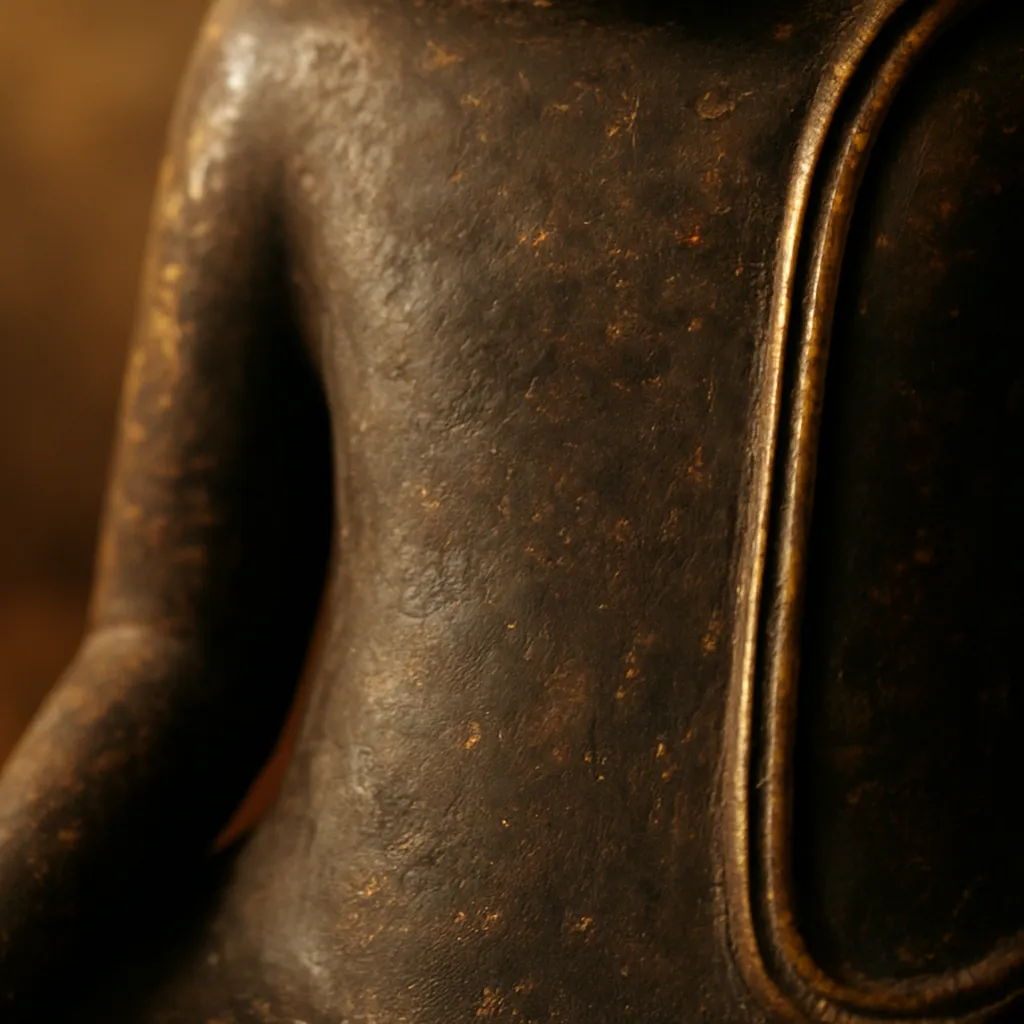
The design collectors call the flat-iron phim, more precisely lang taolit (หลังเตารีด), “iron-backed,” is the visual signature of the early Wat Chang Hai tradition. The phim, mould type, takes its name from the reverse of the piece, flat and broadly triangular, tapering toward the top the way the sole of a traditional charcoal pressing iron does; the front carries the seated figure of the monk, robed and cross-legged, in low relief against that same solid silhouette. Ajahn Tim’s 2505 BE (1962) batch introduced this design and remains one of his most celebrated editions after the 1954 first batch; the visual template it set is still echoed by tribute editions issued across the country today.
Rian, coin-format pieces, form the tradition’s second major physical category, produced across the full range of eras discussed above and offering an entry point that does not require engaging with the powder-body vintage market at all. Bucha images, statues sized for a home altar rather than for wearing, exist for LP Thuad as they do for most major devotional figures, distinct from the object described here in scale and purpose; the glossary entry on bucha covers the category generally. LP Thuad’s public devotional presence extends further still: temples have built monumental statues explicitly separate from the amulet tradition, including an approximately 11.5-metre seated figure at Wat Huay Mongkol near Hua Hin, completed in 2004, later surpassed by a roughly 59-metre statue, including its base, at Luang Pu Thuad Buddha Park in Khao Yai, Nakhon Ratchasima. Neither site holds any consecration link to Wat Chang Hai; both exist because the image itself had already become a shared national one, recognizable with or without an amulet attached to it.
Recognizing the basic flat-iron silhouette and telling a rian from a powder-body piece are the first two things a newcomer needs. Working out which specific phim variant, block, or year a given piece belongs to is a different and much harder task; the Thai Amulet Authentication guide covers how that certification work actually happens and who does it.
The Market Landscape
LP Thuad is reported here as the largest single-figure amulet market in Thailand by volume, a scale that follows directly from seventy years of continuous production across dozens of temples, rather than from any single celebrated edition. Reporting on it means describing what exists, not recommending where to look.
At the top of the market, apex pieces from the 1954 first batch, particularly the large committee-code variant, trade at roughly THB 5 million to THB 10 million and above (approximately USD 140,000 to USD 280,000 and above, as of August 2026), with price driven by documented provenance, block and phim identification, and competition results, not by age alone. Later Wat Chang Hai editions and Ajahn Nong’s Wat Sai Khao pieces occupy a substantial middle tier, priced for their documented ties to the founding network rather than at first-batch levels. New-production temple-counter editions and rian from active temples sit at the accessible end, available at prices well within ordinary devotional spending.
What drives value across every tier is the same set of factors: which era and maker, which specific phim and block, what documentation exists connecting a piece to its issuing ceremony, and, for the highest tier, results from the judged competition circuit. The Thai Amulet Market Guide covers how that certification and competition ecosystem functions for the market generally; the sian phra, expert collector, circuit that adjudicates it applies to LP Thuad exactly as it does to every other major tradition.
LP Thuad’s popularity carries a direct consequence: reproduction is more widespread for this figure than for almost any other in Thai devotional culture, a known and openly discussed feature of the market rather than a hidden problem. The ecosystem’s answer is institutional, the same certification bodies, association-run competitions, and expert examination described in the authentication guide, not a set of tips for spotting a fake. A newcomer’s most useful habit is the one already described above: read what a piece’s own issuing temple and monk actually document, and treat that documentation, not age or resemblance to a famous phim, as the starting point.
LP Thuad in Daily Devotion
For most people who wear LP Thuad, none of the market distinctions above matter day to day. Devotees hold that the amulet answers khlaeo khlat, escape from harm, specifically, which is why it travels with people whose work puts them in harm’s way and why it is worn above the waist alongside other protective objects rather than displayed or handled casually. Temple-specific katha, invocations, exist for LP Thuad within individual temples’ own practice; because their exact wording varies by temple and is not consistently published in a verifiable printed form, none is reproduced here.
The sea miracle at the center of the legend gives the amulet its strongest secondary association, travel safety, which is why it appears so often with drivers, sailors, and anyone whose ordinary day involves motion through unpredictable risk. That practical, embodied logic, an object answering a specific named danger rather than functioning as a general good-luck charm, is the throughline connecting the legend, the production history, and the way ordinary devotees actually use the object today.
Where LP Thuad Fits
LP Thuad occupies a genuinely dual position in Thai amulet culture: he is simultaneously the most actively collected figure in the market, with a competition and certification apparatus as developed as any other tradition’s, and the most common object worn by people who are not collectors at all and never will be. Few other figures span both worlds so completely. That dual status is what makes LP Thuad the clearest single window into how Thai Buddhist amulet culture actually functions, as devotion first, with a market that has grown up around it rather than the other way around.
For the classical central-Thai tradition this guide sits alongside, see the Benjapakee pillar; for LP Thuad’s full biography and legend, the monk profile is the fuller account; and for how consecration itself works across the tradition generally, see the guide to consecration.